


How to Choose the Right FHA-Approved Lender matters almost as much as choosing the FHA loan itself. FHA rules create the basic framework, but individual lenders can differ in rates, fees, underwriting standards, service, loan programs, and closing experience.
The best FHA-approved lender is not necessarily the lender advertising the lowest rate. The better choice is the lender offering a competitive overall cost, suitable FHA options, clear communication, reasonable fees, and a realistic path to closing.
An FHA loan is insured by the Federal Housing Administration but originated by private lenders. FHA financing can offer down payments as low as 3.5% for qualifying borrowers, while borrowers with lower credit scores may face a larger required down payment.
That distinction is important because two lenders can offer the same FHA program while giving you very different loan terms.
This guide explains exactly what to look for, which questions to ask, how to compare Loan Estimates, what red flags to avoid, and how to determine whether a lender is actually a good fit for your situation.

How to Choose the Right FHA-Approved Lender
Start with a shortlist of at least three lenders or mortgage professionals. Then compare the same FHA loan scenario across each one.
A useful comparison should include:
- Interest rate
- Annual percentage rate (APR)
- Loan amount
- Down payment
- Monthly principal and interest
- FHA mortgage insurance
- Origination charges
- Lender credits
- Other closing costs
- Rate-lock terms
- Estimated cash to close
- Expected closing timeline
- Communication and customer service
- Experience with your specific borrower profile
The Consumer Financial Protection Bureau recommends requesting and comparing multiple Loan Estimates because standardized estimates make it easier to compare mortgage offers.
What makes an FHA-approved lender different?
An FHA-approved lender has authorization to originate FHA-insured mortgage loans. HUD maintains a lender search tool that allows consumers to locate FHA lenders by factors such as location, business area, lender type, and certain FHA programs.
However, FHA approval does not automatically mean a lender is the best lender for you.
The lender still determines its own pricing and may apply additional underwriting requirements, often called overlays.
For example, FHA guidelines may permit a particular borrower profile, while one lender may have stricter internal requirements. Another FHA-approved lender may be more comfortable with that same situation.
That is one of the biggest reasons shopping around matters.
1. Compare FHA Rates and APR, Not Just the Advertised Rate
Interest rate is important, but it should not be the only number you compare.
Your APR incorporates the interest rate plus certain fees and charges, making it a broader measure of borrowing cost. The CFPB explains that the interest rate appears on page one of the Loan Estimate, while APR appears in the Comparisons section on page three.
Why APR can reveal a different deal
Imagine two lenders offer the following hypothetical FHA scenarios:
Lender A
- Interest rate: 6.25%
- Lower upfront fees
- Small lender credit
- APR: 6.48%
Lender B
- Interest rate: 6.125%
- Higher points and lender fees
- APR: 6.51%
Lender B has the lower advertised interest rate, but Lender A could have the lower overall borrowing cost depending on your circumstances.
This is a practical comparison lesson: never choose an FHA lender based on a rate shown in an advertisement alone.
Rates can also change between quotes. For a fair comparison, request Loan Estimates for the same loan type, loan amount, down payment, and property scenario as close together as possible.
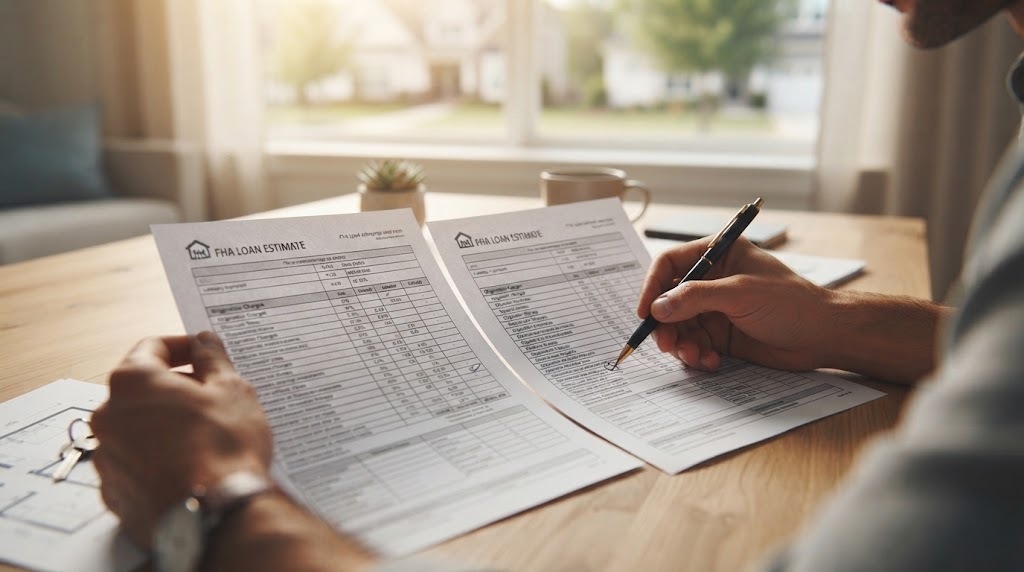
2. Examine FHA Lender Fees and Closing Costs
The cheapest-looking FHA rate can become less attractive when lender fees are added.
Review the Loan Estimate carefully, particularly:
- Origination charges
- Discount points
- Underwriting fees
- Processing fees
- Application fees
- Rate-lock fees
- Lender credits
- Required services
- Estimated cash to close
The CFPB recommends comparing origination charges and lender credits when evaluating multiple Loan Estimates.
Also separate costs controlled by the lender from costs that are largely outside its control.
Property taxes, homeowners insurance, and certain government charges can vary because of the property or location. A lender may not be responsible for those differences.
Be careful with “no closing cost” FHA loans
“No closing costs” does not necessarily mean the costs disappear.
A lender may offset closing costs through lender credits, which can involve a higher interest rate. In other cases, costs may be added to the loan balance.
Ask:
“How much will this option cost me upfront, monthly, and over the period I expect to keep the loan?”
That question produces a much better comparison than simply asking which lender has the lowest rate.
3. Check the Lender’s FHA Experience
FHA loans have specific requirements involving credit, income, debt, property condition, mortgage insurance, documentation, and appraisal.
A lender that regularly handles FHA transactions may be better prepared to identify potential problems before they delay your closing.
Ask the lender:
- How many FHA loans do you typically close?
- Do you regularly work with first-time buyers?
- Do you offer FHA 203(k) loans if renovation financing is needed?
- How do you handle borrowers with lower credit scores?
- How do you review employment gaps or variable income?
- Which down payment assistance programs can be combined with FHA financing?
- Who will be my primary point of contact?
- How quickly can you issue a preapproval?
- What is your typical FHA closing timeline?
You do not necessarily need the biggest lender.
A smaller lender or mortgage broker can sometimes provide more personalized communication, while a large national lender may offer extensive digital tools and broad availability. The right choice depends on what matters most to you.
4. Understand FHA Credit and Underwriting Requirements
One common mistake is assuming that every FHA-approved lender uses exactly the same credit standards.
The FHA framework allows qualifying borrowers with credit scores as low as 500 in certain circumstances, but a 500–579 score generally requires at least 10% down, while 580 or higher can qualify for the 3.5% minimum down payment under FHA rules. Lenders may impose stricter requirements.
That means your credit score should influence which lenders you contact.
If your credit score is below 620
Do not automatically assume you cannot get an FHA loan.
Instead, ask potential lenders:
- What is your minimum FHA credit score?
- Do you have credit-score overlays?
- How do you handle recent late payments?
- How do you evaluate collections?
- How do you treat previous bankruptcy or foreclosure?
- Can you provide a written preapproval after reviewing my documentation?
A lender willing to discuss your complete financial picture is often more useful than one that gives you a generic answer based only on a credit-score threshold.
5. Choose a Lender That Fits Your Property and Loan Type
Not every FHA lender specializes in every FHA scenario.
Before choosing a lender, confirm that it handles your particular transaction.
Examples include:
- FHA purchase loans
- FHA refinance loans
- FHA Streamline Refinance
- FHA 203(k) renovation loans
- Manufactured housing
- Multi-unit properties
- First-time homebuyer transactions
- Down payment assistance programs
Wells Fargo, for example, notes that FHA financing can offer flexible credit and income guidelines and down payments as low as 3.5%, while FHA loans also involve upfront and ongoing mortgage insurance costs.
If your situation involves a property type or loan program outside a lender’s everyday workflow, ask about that before submitting an application.
Why this matters
A lender can be excellent for standard FHA purchases but less experienced with a renovation loan.
Likewise, a lender with attractive pricing may not offer the assistance program you need.
The right lender is therefore the lender that fits your transaction, not simply the lender with the most recognizable name.
6. Compare the Loan Estimate Line by Line
Once you are serious about a lender, the Loan Estimate becomes one of your most useful comparison tools.
A Loan Estimate is a standardized three-page document that shows important information about the proposed mortgage. Lenders generally must provide it within three business days after receiving the required application information.
Compare these areas:
Loan terms
Check:
- Loan amount
- Interest rate
- Loan term
- Whether the rate is fixed or adjustable
- Monthly principal and interest
Projected payments
Check:
- Principal and interest
- Mortgage insurance
- Property taxes
- Homeowners insurance
- Estimated total monthly payment
Closing costs
Focus on:
- Origination charges
- Services
- Lender credits
- Prepaid expenses
- Estimated cash to close
Five-year cost
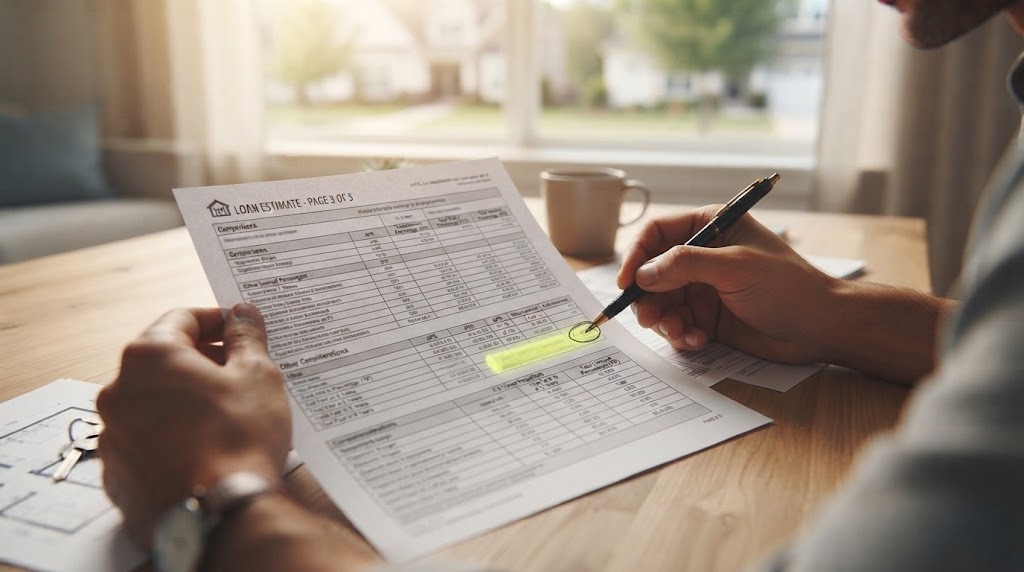
The CFPB also recommends examining the “In 5 years” calculation in the Loan Estimate’s Comparisons section. You can use it to understand the interest and fees associated with the loan over the first five years.
This can be especially useful when two lenders have similar rates but different upfront charges.
7. Evaluate Customer Service and Closing Reliability
Mortgage shopping is not only about numbers.
Your lender will handle a large amount of sensitive financial information and communicate with your real estate agent, title company, appraiser, and other parties.
Ask yourself:
- Does the loan officer answer questions clearly?
- Are estimates explained rather than simply emailed?
- Are requests for documents organized?
- Do you receive updates when something changes?
- Can you reach someone when you need help?
- Does the lender understand your purchase contract deadline?
A slightly cheaper loan can become frustrating if poor communication creates avoidable delays.
The CFPB specifically recommends considering whether you are comfortable with the loan officer’s ability to answer questions and whether you trust the lender to meet your closing timeframe.
8. Verify the Lender and Loan Officer
Before choosing an FHA-approved lender, verify that the company is legitimate and that the person handling your mortgage is properly authorized.
HUD provides an official FHA lender search tool.
You can also check the loan officer through the Nationwide Multistate Licensing System and Registry (NMLS). The CFPB notes that consumers can use NMLS information to check whether a mortgage professional is authorized to operate in a state and whether disciplinary information is listed.
Look for:
- Proper licensing
- FHA lending experience
- Transparent contact information
- Consistent reviews
- Clear fee explanations
- Professional communication
Online reviews should be one input, not your entire decision. A lender with thousands of reviews may not necessarily be the best fit for your particular loan.
9. Ask These Questions Before Selecting an FHA Lender
Before you commit, ask each lender the same questions.
Rate and pricing questions
- What is today’s FHA interest rate?
- What is the APR?
- How many points are included?
- What lender fees will I pay?
- Are there lender credits?
- How long can you lock my rate?
Qualification questions
- What is your FHA minimum credit score?
- Do you have additional FHA overlays?
- How do you evaluate debt-to-income ratios?
- Can you work with variable income?
- What documentation will I need?
Closing questions
- How long does a typical FHA purchase take to close?
- Who handles underwriting?
- What happens if the appraisal identifies an issue?
- Who will communicate with my real estate agent?
- What could delay my closing?
Program questions
- Do you offer FHA 203(k)?
- Do you work with down payment assistance?
- Can you help compare FHA with conventional financing?
- Do you offer FHA refinance options?
A good loan officer should be comfortable answering these questions directly.
10. Watch for FHA Lender Red Flags
Choosing the wrong lender can create unnecessary costs and stress.
Be cautious if a lender:
- Refuses to provide clear fee information
- Focuses only on the lowest advertised rate
- Cannot explain APR
- Pressures you to decide immediately
- Gives estimates that change without explanation
- Avoids providing a Loan Estimate when appropriate
- Cannot explain FHA mortgage insurance
- Makes promises that sound too good to be true
- Communicates poorly after receiving your application
- Has difficulty explaining who is responsible for each step
A lender does not have to be perfect, but transparency should be non-negotiable.
What FHA Costs Should You Understand Before Choosing a Lender?
FHA mortgage insurance is one of the biggest differences between FHA and conventional financing.
For most forward FHA mortgages, the upfront mortgage insurance premium is 1.75% of the base loan amount. An annual MIP is generally collected in monthly installments, with the applicable amount depending on factors such as loan amount, loan-to-value ratio, and loan term.
These program-level costs should not be confused with lender-specific pricing.
Your lender can influence items such as:
- Interest rate
- Discount points
- Origination charges
- Certain lender fees
- Lender credits
The FHA program itself establishes many requirements and insurance costs.
That distinction makes comparing lenders much easier: separate government-program costs from lender-controlled costs.
What Are the 2026 FHA Loan Limits?
For 2026, HUD lists a nationwide FHA forward mortgage limit floor of $541,287 and a one-unit ceiling of $1,249,125, with limits varying by location and property type.
Do not rely on an old article for the applicable loan limit.
Your actual maximum may depend on:
- County
- Property type
- Number of units
- FHA’s annual limits
- Your qualifying financial profile
Ask the lender to verify the current limit for the property you are considering.
FHA Lender vs. Mortgage Broker: Which Should You Choose?
A direct lender originates mortgages directly for consumers.
A mortgage broker generally works as an intermediary and may have access to multiple wholesale lenders.
Neither option is automatically better.
A direct lender may provide:
- Direct access to its own loan products
- Integrated technology
- Established processing systems
- Branch or call-center support
A mortgage broker may provide:
- Access to multiple lenders
- More options for comparing pricing
- Assistance matching your profile with lender guidelines
- Help navigating specialized borrower scenarios
The important question is not whether the company is a bank, broker, credit union, or online lender.
The important question is:
Can this professional provide a competitive FHA loan that fits my financial situation and closing timeline?
A Simple 7-Step FHA Lender Comparison Strategy
If you want a practical process, use this checklist:
Step 1: Check your credit, income, debts, and available funds.
Step 2: Identify at least three potential FHA lenders.
Step 3: Verify FHA participation and licensing.
Step 4: Give each lender the same basic loan scenario.
Step 5: Request comparable Loan Estimates when possible.
Step 6: Compare rate, APR, lender fees, credits, monthly payment, cash to close, and five-year cost.
Step 7: Choose the lender that provides the best combination of cost, loan fit, service, and closing reliability.
This approach is more reliable than choosing a lender from a single online ranking.
Final Thoughts: Choosing the Right FHA-Approved Lender
Learning how to choose the right FHA-approved lender can save you money and make the mortgage process considerably easier.
Start with several lenders instead of accepting the first quote. Verify FHA participation, compare Loan Estimates, examine APR and lender-controlled fees, and ask detailed questions about credit requirements, loan programs, closing timelines, and customer service.
Most importantly, compare the complete loan offer, not just the advertised interest rate.
HUD’s official lender search can help you identify FHA lenders, while CFPB resources can help you understand and compare Loan Estimates.
If you are deciding between FHA lenders, use this guide as your checklist and request comparable offers before making your final decision.
FAQ: Choosing an FHA-Approved Lender
How do I choose the right FHA-approved lender?
Compare at least three FHA lenders based on interest rate, APR, lender fees, credits, monthly payment, cash to close, FHA experience, communication, and closing timeline. The lowest advertised rate is not always the lowest-cost loan.
How do I find an FHA-approved lender?
You can use HUD’s official FHA Lender List Search to identify lenders and narrow results by location, lender type, and certain FHA programs.
Should I compare FHA lenders by interest rate or APR?
Compare both. The interest rate measures the cost of borrowing, while APR incorporates the interest rate plus certain fees and charges. APR can provide a broader comparison, although it should not be the only factor in your decision.
How many FHA lenders should I compare?
Three is a useful starting point. Comparing multiple Loan Estimates can help you identify differences in rates, fees, credits, and loan terms and can give you information to negotiate.
Can FHA-approved lenders have different requirements?
Yes. FHA establishes the program’s basic requirements, but individual lenders can apply additional underwriting standards, often called overlays. This is why one lender may approve a borrower while another lender does not.
What should I look for on an FHA Loan Estimate?
Review the loan amount, interest rate, monthly payment, mortgage insurance, origination charges, lender credits, estimated cash to close, APR, and five-year cost of borrowing. The CFPB recommends using Loan Estimates to compare offers from multiple lenders.







One Response