
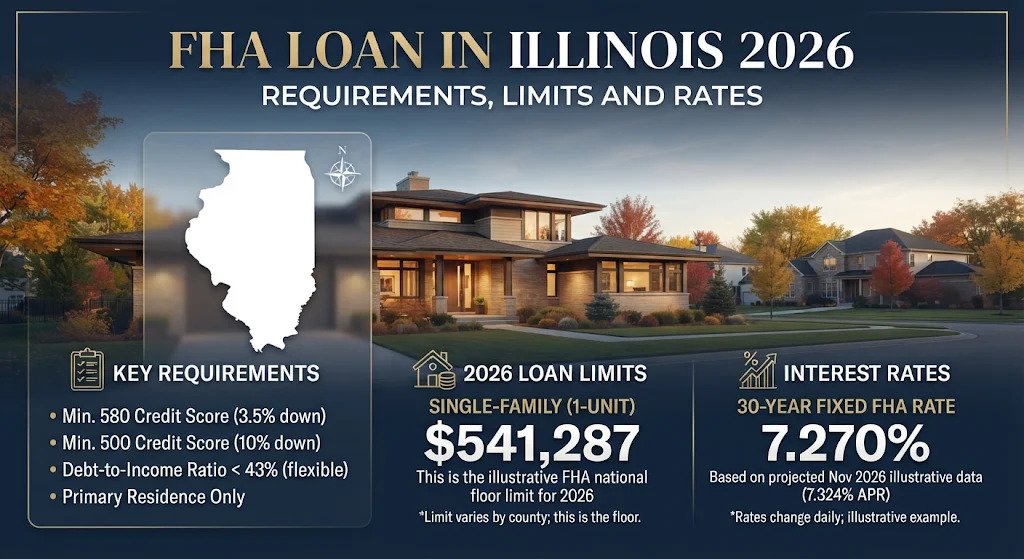

An FHA loan in Illinois is one of the most practical ways to buy a home in 2026, especially for first time buyers or buyers whose credit score is not perfect. With a 580 credit score you can buy with just 3.5% down, and the 2026 FHA loan limit for a single family home is $541,287 in every one of Illinois’ 102 counties, including Cook County and the whole Chicago metro area. This guide explains the 2026 limits, the requirements, what the loan costs each month, and the Illinois down payment help available.
2026 FHA Loan Limits in Illinois
HUD announced the 2026 FHA loan limits in Mortgagee Letter 2025-23 (December 11, 2025). They apply to FHA case numbers assigned on or after January 1, 2026. The national floor for a one unit home in 2026 is $541,287, and the national ceiling for the most expensive areas is $1,249,125. Illinois sits at the floor: no Illinois county is designated as a high cost area by HUD, so the same $541,287 limit applies in Chicago, the suburbs and every downstate county alike.
HUD puts the median sale price in the Chicago-Naperville-Elgin metro area at $455,000, comfortably below the $541,287 limit. The limit caps the loan amount, not the home price. With the minimum 3.5% down, a $541,287 loan covers a home priced at about $560,900. For a more expensive home, you will need a larger down payment or a different loan type.
| Property type | 2026 FHA loan limit in Illinois |
|---|---|
| One unit (single family home) | $541,287 |
| Two unit property | $693,050 |
| Three unit property | $837,700 |
| Four unit property | $1,041,125 |
The higher limits for two to four unit properties matter if you want to buy a small multi family home, live in one unit and rent out the others, and the rental income can help you qualify. See this 2026 FHA loan limits guide for the national breakdown.
FHA Loan Limits in Chicago and the Suburbs
Chicago area buyers sometimes assume their limit is higher because city home prices are higher than downstate. It is not. Cook, DuPage, Lake, Kane, McHenry and Will counties all use the same $541,287 limit, because no Illinois county is on HUD’s 2026 higher cost list.
In the city and inner suburbs, $541,287 buys a solid condo or a modest house. In the outer suburbs and downstate cities such as Springfield, Rockford, Peoria and Champaign, the same loan buys considerably more. Check your exact county with HUD’s FHA mortgage limits lookup tool. The Illinois FHA loan limits by county page lists all 102 counties at $541,287 for 2026.
FHA Loan in Illinois: Requirements for 2026
An FHA loan in Illinois follows the same national rules as everywhere else, though state factors such as property taxes and down payment assistance do shape how much house you can afford.
Credit Score and Down Payment
With a credit score of 580 or higher, you can buy with 3.5% down, the smallest down payment of any major loan program. With a score between 500 and 579, you can still qualify with 10% down. Below 500, FHA financing is not available. Many lenders set their own minimums above FHA’s floor, often 580 or 620, so compare lenders if your score is near the edge. Our guide on buying with a 500 credit score explains what to expect.
Debt to Income Ratio
Your lender will look at two ratios. The front end ratio compares your housing costs to your gross monthly income, and FHA guidelines generally allow up to about 31%. The back end ratio compares all of your monthly debts to your gross income, and the guideline is generally around 43%. Lenders can approve higher ratios with compensating factors such as a larger down payment or cash reserves. See our FHA debt to income requirements guide.
Primary Residence and Property Rules
The home must be your primary residence, and you must move in within 60 days of closing. FHA loans cannot be used for investment or vacation properties. The home must also pass an FHA appraisal and meet HUD’s minimum property requirements: safe, sound and secure, with working heat, plumbing and electrical systems, a sound roof and no serious health or safety hazards. A home needing major repairs will fail the appraisal unless the seller fixes the problems before closing or you use a renovation loan. Condos must be in an FHA approved project or meet the single unit approval rules.
Employment, Income and Documentation
You need a steady two year employment history, though not with the same employer, and gaps are acceptable if explained. You will need pay stubs, W-2s or tax returns, bank statements and ID. Self employed buyers should expect to provide two years of tax returns. Gifts from family are allowed for the down payment but must be documented with a gift letter and a paper trail.
FHA Loan in Illinois: What It Costs
The interest rate on an FHA loan in Illinois moves daily with the market and depends on your credit score, down payment and lender, so any rate quoted in an article is out of date within days. What does not change is the mortgage insurance structure, and that is where FHA’s real cost sits. Every FHA loan carries two insurance premiums.
The upfront mortgage insurance premium is 1.75% of the base loan amount. On a $337,750 loan that is about $5,911, and most buyers roll it into the loan balance rather than paying cash at closing. The annual premium is 0.55% a year for most 30 year loans with less than 5% down, paid monthly. With 5% or more down, the annual rate drops to 0.50%. These rates come from HUD Mortgagee Letter 2023-05, still in force in late 2026.
With less than 10% down, the annual premium lasts for the life of the loan and can only be removed by refinancing into a conventional loan. With 10% or more down, it drops off after 11 years. Our FHA mortgage insurance cost guide has the full breakdown.
| Cost item | Amount (illustrative example) |
|---|---|
| Home price | $350,000 |
| Down payment (3.5%) | $12,250 |
| Base loan amount | $337,750 |
| Upfront MIP (1.75%, financed) | $5,911 |
| Annual MIP, year one (0.55%) | About $1,858 per year, or about $155 per month |
| Total loan balance after UFMIP | About $343,661 |
The example above is illustrative. Your own payment will also include principal and interest, property taxes, homeowners insurance and any HOA dues. Illinois property taxes are among the highest in the country, and in Cook County they can add several hundred dollars a month, so ask your lender for a full payment estimate including taxes and insurance before you make an offer. Use our FHA monthly payment calculator to model different prices.
Down Payment Help in Illinois
If saving 3.5% plus closing costs feels out of reach, Illinois has one of the stronger state assistance programs in the country. The Illinois Housing Development Authority, or IHDA, runs several homebuyer programs, including Opening Doors, Access Home, Access Forgivable, Access Deferred and Access Repayable, offering down payment and closing cost help, usually as a forgivable or deferred second loan. Every Illinois county is eligible.

One catch: IHDA lists a 640 minimum credit score on each of its homebuyer programs, higher than FHA’s own 580 floor. If your score is between 580 and 639, you can still get an FHA loan, but you will likely need to save the down payment yourself or use a gift from family. At 640 or above, IHDA help is worth checking before you buy. The Illinois first time buyer programs page has the IHDA credit rules and current program details.
FHA vs Conventional Loans in Illinois
FHA usually wins when your credit score is below about 680, because FHA charges the same mortgage insurance rate regardless of score, while conventional pricing gets expensive fast at lower scores. Conventional usually wins when your score is above 700 and you can put 20% down, because then there is no mortgage insurance at all, and conventional PMI can be cancelled once you reach 20% equity, while FHA mortgage insurance with less than 10% down lasts for the life of the loan.
The 2026 conforming loan limit for conventional loans is $832,750 statewide, higher than the $541,287 FHA limit. If you are buying a home between those two figures, a conventional loan may be your only low down payment option.
How to Apply for an FHA Loan in Illinois
Applying usually takes 30 to 45 days. Check your credit reports and fix any errors, then get preapproved with an FHA approved lender so you know your price range before you shop. Once you find a home, your lender orders the FHA appraisal, verifies your income and assets, and underwrites the file. Budget for closing costs of roughly 2% to 5% of the loan amount, though sellers in Illinois can contribute up to 6% of the price toward your closing costs. Our FHA loan closing costs guide explains each fee, and our first time home buyer FHA checklist covers the final week.
FAQs
What is the FHA loan limit in Illinois for 2026?
$541,287 for a one unit home in every Illinois county. The limit rises to $693,050 for two units, $837,700 for three units and $1,041,125 for four units.
Is Chicago a high cost area for FHA loans?
No. No Illinois county is on HUD’s 2026 higher cost list, so Chicago uses the same $541,287 floor limit as the rest of the state.
What credit score do I need for an FHA loan in Illinois?
580 or higher for 3.5% down, or 500 to 579 with 10% down. Many lenders set their own minimum at 580 or 620.
How much is the down payment on an FHA loan in Illinois?
3.5% with a 580 credit score, or $12,250 on a $350,000 home. With a score of 500 to 579, the down payment is 10%.
How much is FHA mortgage insurance in Illinois in 2026?
1.75% upfront, usually financed into the loan, plus 0.55% a year for most 30 year loans with less than 5% down.
Does FHA mortgage insurance ever go away?
With less than 10% down, it lasts for the life of the loan and only refinancing into a conventional loan removes it. With 10% or more down, it drops off after 11 years.
Can I get down payment assistance for an FHA loan in Illinois?
Yes, through the Illinois Housing Development Authority (IHDA). IHDA requires a 640 minimum credit score, higher than FHA’s 580 floor.
What is the maximum home price I can buy with an FHA loan in Illinois?
With 3.5% down, a $541,287 loan covers a home priced at about $560,900. With a larger down payment, you can buy a pricier home as long as the loan stays under $541,287.
Do I have to live in the home with an FHA loan in Illinois?
Yes. It must be your primary residence, and you must move in within 60 days of closing.
How long does it take to close an FHA loan in Illinois?
Usually 30 to 45 days, assuming the appraisal passes and your documents are in order.
Can a seller contribute to my closing costs on an FHA loan in Illinois?
Yes, up to 6% of the sale price toward your closing costs.
Is an FHA loan or a conventional loan better in Illinois?
FHA is usually better below about a 680 credit score or with a small down payment. Conventional is usually better above a 700 score, and it is the only option for homes priced between the $541,287 FHA limit and the $832,750 conforming limit.
#FHALoanIllinois #IllinoisFHALoan #FHALoanLimits2026 #ChicagoFHALoan #FHADownPayment #FHALoanRequirements






