


How Your Credit Score Affects Your FHA Loan Rate is an important question for anyone planning to use an FHA mortgage in 2026. Your credit score can influence whether you qualify, which FHA options are available to you, and the pricing a lender offers.
The important point is that an FHA loan does not work like a simple chart where every credit score automatically receives a specific interest rate. FHA sets program rules, while individual lenders price loans based on the complete borrower profile and current market conditions. Your credit score is one important part of that picture.
The Consumer Financial Protection Bureau explains that mortgage lenders generally review credit information, debt, income, assets, and other financial factors when deciding whether to approve a mortgage and what rate to offer.
So, does a higher credit score always mean a lower FHA rate? Not necessarily, but a stronger score can improve your overall mortgage profile and may help you qualify for better pricing with a particular lender.
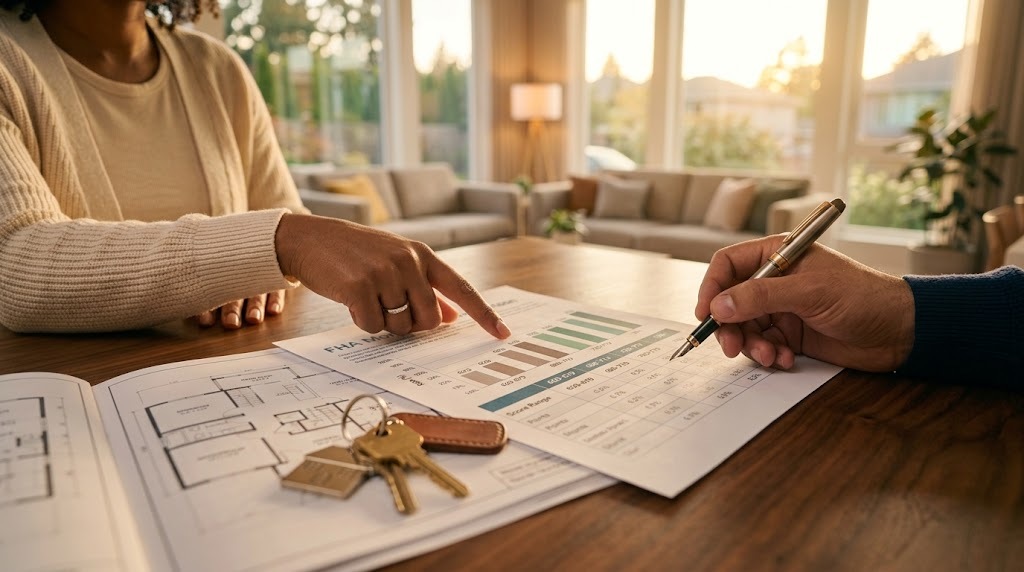
How Your Credit Score Affects Your FHA Loan Rate
Your credit score is a numerical summary of information in your credit history. Mortgage lenders use credit information to evaluate the likelihood that you will repay your debts as agreed.
For FHA financing, the score can matter in several ways:
- It can affect your eligibility for certain FHA terms.
- It can influence the minimum down payment required under FHA guidelines.
- It can affect how lenders evaluate the overall risk of your application.
- It can influence the pricing or fees a lender offers.
- It can affect whether another loan program may be cheaper for your situation.
The FHA program generally permits borrowers with qualifying credit scores of 580 or higher to make a 3.5% minimum down payment. Borrowers with scores from 500 through 579 generally need at least 10% down, while borrowers below 500 are not eligible for FHA insurance under the standard FHA rules.
That distinction matters because the lowest possible FHA rate is not necessarily the best financial outcome for every borrower. Your down payment, mortgage insurance, loan amount, lender pricing, and other costs also matter.
FHA rates are not determined by credit score alone
A common misconception is that FHA publishes one interest rate for a 580 score, another for 620, and another for 740.
It is more complicated.
FHA insures loans made by approved private lenders. The lender provides the mortgage and determines its pricing based on the market, borrower characteristics, loan structure, and its own pricing policies. The CFPB also notes that FHA loans can be particularly useful for borrowers with lower credit scores or smaller down payments, although the overall cost depends on the individual situation.
This is why two borrowers with the same FHA credit score can receive different quotes.
What Credit Score Is Best for an FHA Loan?
There is no single “perfect” FHA score. Instead, think about your score in terms of eligibility, lender options, and pricing.
Below 500
A credit score below 500 generally does not meet FHA’s standard minimum requirement for FHA insurance.
If your score is in this range, improving your credit before applying may be more productive than immediately shopping for an FHA mortgage.
500 to 579
Borrowers in this range may qualify for FHA financing, but the standard FHA minimum down payment is generally 10%.
Some lenders may also impose their own credit requirements that are stricter than FHA’s baseline rules.
580 to 619
A score of 580 or above can open the door to the FHA 3.5% minimum down payment option when the borrower otherwise meets program requirements.
However, moving from the high 500s into the 600s can strengthen your overall application and may give you access to more lender choices.
620 to 679
This is an important range for borrowers comparing FHA with conventional financing.
A borrower may qualify for FHA with a score below 620, but someone in the 620s or higher may have more options to compare. The right choice depends on down payment, mortgage insurance, interest rate, closing costs, and the borrower’s complete financial profile.
680 and above
A higher score generally presents a stronger credit profile. The CFPB says borrowers with scores in the mid to high 700s or above generally receive the lowest mortgage rates, while borrowers in lower ranges can face higher rates or fewer choices.
That does not mean you must have a 740 or 760 score to get a competitive FHA mortgage. It means you should compare actual loan offers rather than assuming the FHA label guarantees the best deal.

How Much Can a Credit Score Change Your FHA Mortgage Cost?
There is no universal FHA rate adjustment that can accurately tell every borrower, “Your score increased by 20 points, so your rate will fall by exactly X%.”
The actual impact depends on the lender, market conditions, loan amount, loan to value ratio, property type, occupancy, loan term, discount points, and other factors.
That is one of the biggest gaps in many general mortgage articles. They show a conventional mortgage example and make it sound like the same pricing table applies directly to FHA loans.
It does not.
For example, Bank of America currently illustrates how a credit difference can produce a substantial cost difference on a $300,000 conventional mortgage. Its example uses national average pricing rather than an FHA rate quote and shows more than $91,000 in lifetime interest difference between two credit ranges.
The lesson is useful, but the numbers should not be copied into an FHA calculator as though they represent an FHA pricing schedule.
A practical FHA example
Imagine two buyers are purchasing the same $300,000 home.
Buyer A
- Credit score: 580
- FHA minimum down payment: potentially 3.5%
- Smaller down payment
- More limited lender options
Buyer B
- Credit score: 700
- FHA minimum down payment: potentially 3.5%
- Stronger credit profile
- More opportunities to compare lenders and loan structures
Even if both buyers qualify for FHA financing, their final mortgage offers can differ.
The difference may come from the lender’s pricing, credit risk assessment, loan structure, closing costs, and other characteristics of the transaction.
Original insight: A 20 point score improvement is not automatically valuable because it crosses a magic FHA rate threshold. Its value comes from what that improvement changes in the borrower’s complete loan profile. Before paying a company to “boost” your score, ask the lender whether the higher score would actually change the loan pricing or approval terms enough to justify the cost.
What Other Factors Affect Your FHA Loan Rate?
Your credit score affects the mortgage decision, but it is not working alone.
Loan to value ratio
Your loan to value ratio compares the mortgage amount with the property’s value.
A larger down payment generally means you are borrowing less relative to the home’s value. This can change the risk profile and may affect lender pricing.
Loan amount
The size of your mortgage can affect pricing. Certain loan amounts can fall into different pricing categories, so comparing a rate requires looking at the actual loan amount rather than the credit score alone.
Property type
The property you purchase can matter. A primary residence, second home, investment property, condominium, and other property types can carry different requirements and pricing considerations.
For FHA borrowers, the property must also meet applicable FHA property and occupancy requirements.
Loan term
A 30 year fixed FHA mortgage is structured differently from other loan terms. The term affects both the interest rate and the total interest you could pay.
Discount points and lender fees
A quoted rate is only part of the cost.
One lender might offer a lower rate with higher upfront points. Another might offer a slightly higher rate with fewer upfront charges.
Always compare the rate, APR, points, lender fees, and total estimated costs together.
Debt and income
Your debt to income ratio can affect whether you qualify and how strong your overall application is. The CFPB lists existing debt, income, assets, savings, and credit information among the factors lenders consider.
Do not assume that improving your credit score alone guarantees approval or a specific rate.
How to Improve Your Credit Before Applying for an FHA Loan
If you are several months away from buying, improving your credit may be worth prioritizing.
1. Check all three credit reports
Mortgage lenders generally review credit information from the major credit reporting companies. The CFPB notes that mortgage lenders commonly look at reports from Equifax, Experian, and TransUnion and may use the middle score when evaluating mortgage pricing.
Check your reports for:
- Incorrect late payments
- Accounts that do not belong to you
- Incorrect balances
- Duplicate accounts
- Outdated information
2. Reduce revolving credit balances
Credit card utilization can be an important part of your credit profile.
If you have high balances relative to your limits, paying them down may improve your credit profile. Avoid using your available credit heavily while preparing for a mortgage.
3. Keep every payment on time
Payment history is a major part of credit scoring. A new late payment shortly before mortgage application can create unnecessary problems.
Set up automatic payments or reminders so you do not accidentally miss a due date.
4. Avoid unnecessary new accounts
Opening several new credit cards or taking out new financing shortly before applying can complicate your mortgage profile.
The CFPB specifically recommends avoiding numerous new credit applications when preparing for a mortgage.
5. Do not close old accounts without understanding the consequences
Closing an old credit card may affect your available credit and the overall profile of your credit history.
Before making major changes, ask how the change could affect your mortgage application.

Should You Wait for a Higher Credit Score Before Getting an FHA Loan?
Sometimes. But not always.
Suppose your score is 575 and you can realistically reach 580 before applying. That five point improvement could be meaningful because 580 is an important FHA threshold for the standard 3.5% minimum down payment option.
Now consider a different borrower with a score of 720 who is trying to reach 740.
That improvement could still help depending on the lender’s pricing, but the financial benefit may be much smaller than the benefit of crossing an important program threshold.
This is why score improvement should be evaluated by its actual financial impact, not simply by the number of points gained.
Before delaying your purchase, ask a lender to price both scenarios:
- Your current credit score.
- Your expected improved score.
- The same loan amount and property.
- The same down payment.
- The same loan term.
- The same rate lock assumptions.
Then compare the difference in monthly payment and total closing costs.
FHA vs. Conventional: Why Your Credit Score Can Change the Best Choice
FHA vs Conventional Loan is not automatically cheaper than a conventional mortgage.
The CFPB notes that FHA loans can be less expensive for borrowers with lower credit scores or smaller down payments, while borrowers with stronger credit and larger down payments may sometimes find conventional financing less expensive.
That makes a side by side comparison essential.
For example, a borrower with a moderate credit score and a small down payment may find FHA attractive because of its flexible credit requirements.
A borrower with a strong credit score and substantial down payment may find a conventional loan more competitive.
Compare:
- Interest rate
- APR
- Upfront costs
- Monthly mortgage insurance
- FHA mortgage insurance
- Down payment
- Closing costs
- Cash required at closing
- Total projected cost
What Should You Do Before Applying for an FHA Loan?
A simple preparation strategy can make your mortgage shopping easier.
Step 1: Check your credit reports.
Step 2: Review your current credit scores.
Step 3: Pay down high credit card balances where possible.
Step 4: Avoid unnecessary new credit.
Step 5: Gather income, employment, asset, and debt documentation.
Step 6: Ask multiple lenders for FHA quotes.
Step 7: Compare the complete loan estimates instead of comparing interest rates alone.
The key is to compare identical loan scenarios. A 6.25% rate with substantial discount points is not necessarily better than a 6.50% rate with fewer upfront costs.
For consumers researching mortgage options,a useful government resource.
The Bottom Line
Your credit score can affect your FHA mortgage experience, but it does not operate as a standalone rate calculator.
A stronger score can improve your eligibility, expand lender choices, strengthen your application, and potentially help you receive better pricing. A lower score can still qualify for FHA financing in many cases, but you may face a larger minimum down payment, stricter lender requirements, or less favorable overall pricing.
The smartest approach is not to chase an arbitrary credit score. Instead, determine how your actual score changes the total cost of your specific FHA loan.
If you are preparing to buy, compare FHA offers from multiple lenders and review the complete costs before choosing a mortgage.
Ready to compare your options? Use an FHA mortgage calculator, review your credit profile, and speak with a qualified mortgage professional about the loan scenario that fits your finances.
FAQ Section
Does credit score affect FHA loan rates?
Yes. Your credit score can affect your overall FHA mortgage pricing and eligibility, although FHA does not publish one universal interest rate for every credit score. Individual lenders consider your score along with loan structure, market conditions, and other borrower factors.
What credit score is needed for a 3.5% FHA down payment?
Generally, FHA guidelines allow a 3.5% minimum down payment for borrowers with a qualifying credit score of 580 or higher. Borrowers with scores from 500 through 579 generally need at least 10% down.
Is 620 a good credit score for an FHA loan?
A 620 score can be workable for FHA financing, assuming you meet the other requirements. However, the best loan choice depends on your entire financial profile, including income, debts, down payment, mortgage insurance, and lender pricing.
Will raising my credit score lower my FHA interest rate?
It may, but there is no guaranteed rate reduction for a specific number of points. The benefit depends on your lender’s pricing and the rest of your loan application. Ask the lender to price your loan at your current score and your expected higher score.
Can I get an FHA loan with bad credit?
Yes. FHA financing is designed to provide access to borrowers who may not qualify as easily for some conventional loans. FHA guidelines generally allow qualifying borrowers with scores from 500 to 579 to use a 10% minimum down payment, while scores of 580 or higher can qualify for the 3.5% minimum down payment option. Individual lenders can have stricter requirements.
Should I choose FHA just because I have a lower credit score?
Not automatically. FHA can be a strong option for borrowers with lower scores or smaller down payments, but a conventional mortgage may be less expensive for some borrowers with stronger credit and larger down payments. Compare the complete costs of both options before deciding.