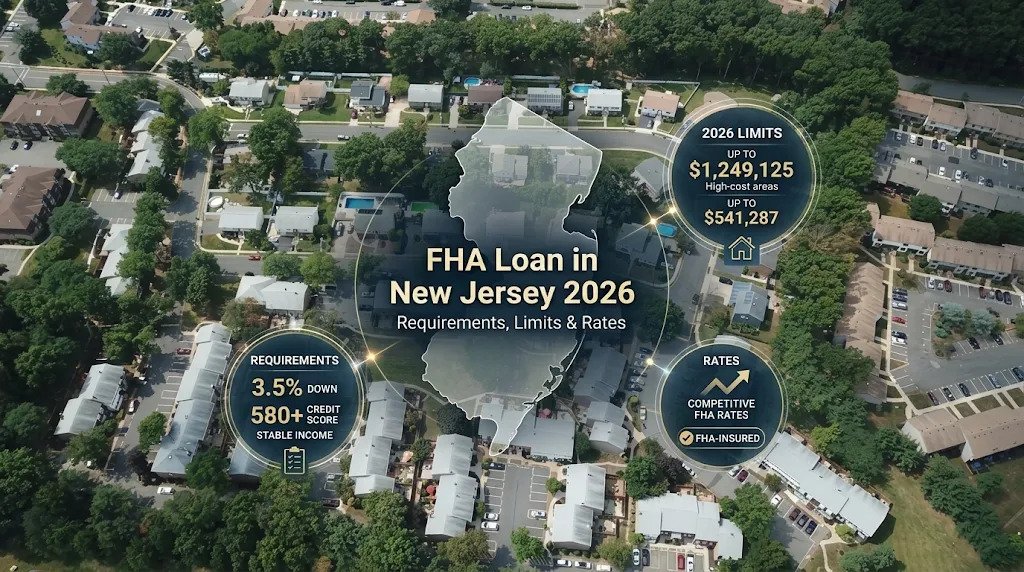

An FHA loan in Maryland follows the same federal rules as everywhere else, because the FHA is a national program. What changes in Maryland is the loan limit for your county, the price of the homes you are shopping for, and the extra help available through the Maryland Mortgage Program. Here is the short version. If your credit score is 580 or higher, you can buy with 3.5 percent down. If your score is between 500 and 579, you need 10 percent down. The FHA loan limit for a single family home in Maryland runs from $541,287 in the lowest cost counties to $1,249,125 in the four Washington metro counties, with the Baltimore metro area at $747,500. You will also pay an upfront mortgage insurance premium of 1.75 percent of the loan amount, plus an annual premium of 0.55 percent for most borrowers, billed monthly.
FHA Loan Limits in Maryland by County
The Department of Housing and Urban Development sets FHA loan limits every year. The current limits come from HUD Mortgagee Letter 2025-23. The national floor for a one unit home is $541,287 and the national ceiling is $1,249,125. Your county decides which number applies to you, not your income and not your lender. Maryland has 24 jurisdictions, and they fall into four tiers. See the 2026 FHA loan limits in Maryland by county for the full breakdown.
| One unit limit | Counties |
|---|---|
| $1,249,125 | Charles, Frederick, Montgomery, Prince George’s |
| $747,500 | Anne Arundel, Baltimore City, Baltimore County, Carroll, Harford, Howard, Queen Anne’s |
| $630,200 | Cecil |
| $541,287 | Allegany, Calvert, Caroline, Dorchester, Garrett, Kent, St. Mary’s, Somerset, Talbot, Washington, Wicomico, Worcester |
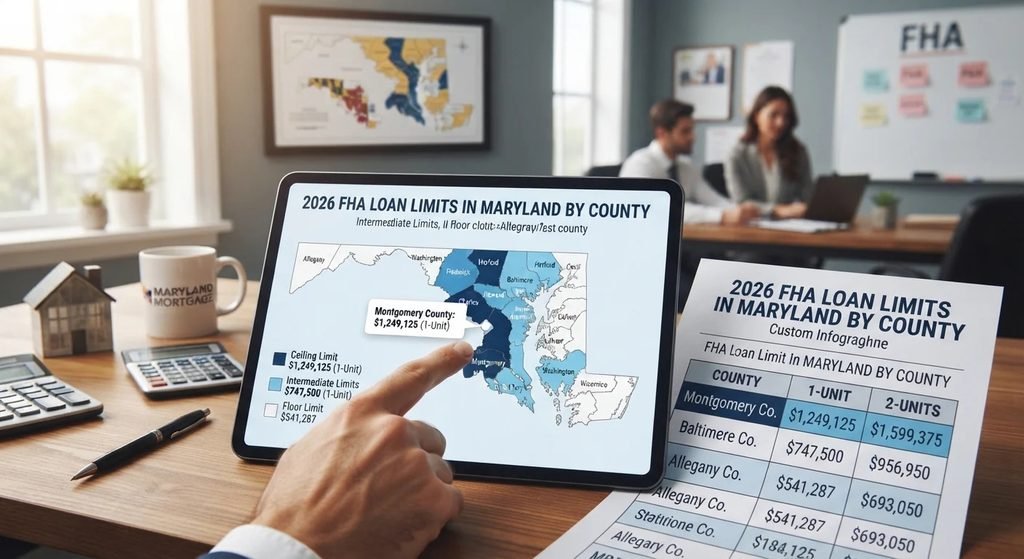
The four counties at the ceiling are all part of the Washington-Arlington-Alexandria metro area, which is why HUD gives them the highest limit. The seven Baltimore metro jurisdictions sit at $747,500. Cecil County is the odd one out at $630,200, because it sits in the Philadelphia metro area. The other twelve counties sit at the national floor of $541,287.
One county deserves a warning. Calvert County fell off a cliff for this year. In 2025 its one unit limit was $1,209,750, because it was counted in the Washington metro area. For the current year HUD moved Calvert out of that metro area, and its limit dropped to the national floor of $541,287, a fall of more than $668,000. If you read an older article that says Calvert buyers can borrow over a million dollars with an FHA loan, that article is out of date. Check the current limit for your county before you make an offer, especially near a county line, because a home a few miles away can carry a very different limit.
The same four tiers apply to two, three and four unit homes, which matter if you plan to buy a duplex or a small multifamily property and live in one unit while renting the others. Baltimore City and Baltimore County have plenty of rowhouses and small multifamily buildings, and an FHA loan is one of the cheapest ways to buy one.
| County tier (one unit) | Two units | Three units | Four units |
|---|---|---|---|
| $1,249,125 | $1,599,375 | $1,933,200 | $2,402,625 |
| $747,500 | $956,950 | $1,156,700 | $1,437,500 |
| $630,200 | $806,750 | $975,200 | $1,211,950 |
| $541,287 | $693,050 | $837,700 | $1,041,125 |
FHA Loan Requirements in Maryland
Because FHA rules are federal, the requirements in Maryland match the national program exactly. HUD Handbook 4000.1 is the rulebook every FHA approved lender follows, in Baltimore the same as in Boise. Here are the numbers that decide whether you qualify.
Credit score. You need a FICO score of 580 or higher to qualify with the minimum 3.5 percent down payment. With a score between 500 and 579, you can still get an FHA loan, but the down payment jumps to 10 percent. Below 500, FHA financing is not available. Lenders can add their own overlays on top of these minimums, so a lender that wants 620 for its own book is allowed to ask for it.
Down payment. The minimum is 3.5 percent of the purchase price with a 580 score. On a $400,000 home in Baltimore County that is $14,000, and on a $700,000 home in Montgomery County it is $24,500. Gift funds from a family member are allowed for the full down payment, and Maryland down payment assistance can cover part of it, which we cover below. What is not allowed is borrowing your down payment from a personal loan, because that debt counts against you in underwriting. If you are planning your cash to close, use the FHA Loan Down Payment Calculator to estimate the full amount, because the down payment is only part of what you pay at closing.
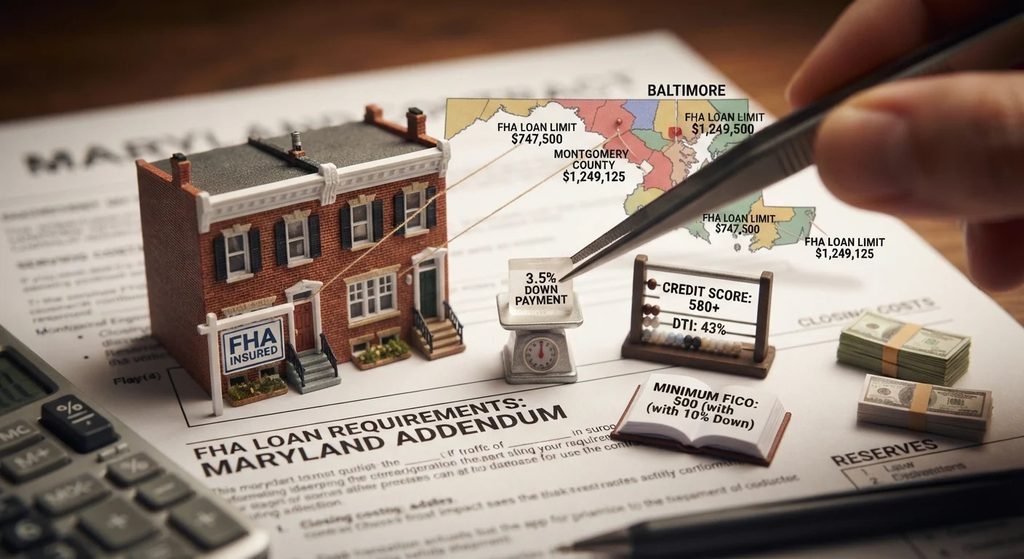
Debt to income ratio. The standard back end debt to income ceiling is 43 percent, meaning your total monthly debts including the new mortgage payment should stay under 43 percent of your gross monthly income. With compensating factors, such as strong cash reserves or a long stable job history, automated underwriting can approve ratios up to about 57 percent. Paying down a car loan or a credit card balance before you apply can be the difference between an approval and a denial.
Income, employment and property. You need a steady two year employment history, or a documented explanation for gaps, such as school or a career change. Self employed borrowers should expect to show two years of tax returns. There is no maximum income limit on an FHA loan itself, though Maryland’s assistance programs do have income limits. The home must be your primary residence, and you have to move in within 60 days of closing. It must also pass an FHA appraisal and meet HUD minimum property standards, covering the roof, foundation, heating, water and electrical safety.
What an FHA Loan Costs Each Month in Maryland
The interest rate is only part of the monthly payment, and Maryland proves it. Take a $500,000 home in Howard County with 3.5 percent down. The down payment is $17,500 and the base loan is $482,500. The upfront mortgage insurance premium is 1.75 percent of the base loan, which is $8,443.75, and most buyers finance it into the loan, bringing the total loan to about $490,944. The annual mortgage insurance premium is 0.55 percent of the base loan for most borrowers, which works out to about $221 a month in the first year.
Then add the rest of the payment. At a rate near 7.28 percent, principal and interest on the $490,944 loan comes to about $3,359 a month. Maryland property taxes run around 1.05 percent of home value on average, though the rate varies a lot by county, so on a $500,000 home that is roughly $437 a month in escrow. Homeowners insurance in Maryland runs roughly $150 to $250 a month for a typical single family home, depending on the county, the age of the roof and flood zone status. Put it together and the total monthly payment lands around $4,150 to $4,250, of which the tax and insurance escrow is more than $600.
That is why shopping the rate alone is not enough. Two homes with the same price in different counties can have monthly payments hundreds of dollars apart, because the property tax rate varies so much from county to county. Before you make an offer, ask your loan officer for the exact monthly tax figure for that specific county and home.
FHA Loan Rates in Maryland Right Now
FHA rates are set by lenders, not by the FHA, and they move every day with the bond market. The benchmark to watch is Freddie Mac’s Primary Mortgage Market Survey. For the week ending November 19, the average 30 year fixed mortgage was 7.28 percent, up from 7.11 percent the week before, and the average 15 year fixed was 6.66 percent. A year earlier the 30 year average was 6.26 percent, so rates are about a full point higher than they were last November.
FHA rates usually sit above the conventional average on paper. In the same week, rate data from Money put the average 30 year FHA mortgage near 7.9 percent APR, while the conventional 30 year was near 7.2 percent. The comparison is misleading, though, because FHA borrowers with lower credit scores often get a better rate through FHA than they would through conventional pricing, where the score drives the rate up sharply. A borrower with a 620 score can easily pay less with an FHA loan than with a conventional loan, even though the headline FHA rate looks higher.
To get a better rate, raise your score before you apply, compare at least three lenders on the same day, and ask about a rate lock once you have a signed contract. Maryland’s assistance loans carry their own rates, which are usually a little higher than a standard FHA rate, because the assistance is built into the deal, so compare the full package, not just the headline rate.
Down Payment Assistance in Maryland: The Maryland Mortgage Program
Maryland has some of the strongest first time buyer help in the country, and it pairs with FHA loans. The main program is the Maryland Mortgage Program, run by the Maryland Department of Housing and Community Development. It is a 30 year fixed rate first mortgage, available as FHA, VA, USDA or conventional, packaged with down payment and closing cost help as a zero percent deferred second loan.
The most popular option is the Maryland Mortgage Program 1st Time Advantage. It offers a flat $6,000, or 3 percent, 4 percent or 5 percent of the first mortgage, as a second loan at zero percent interest with no monthly payments. The assistance comes due only when you sell, refinance, transfer or pay off the first mortgage. On a $400,000 loan, the 5 percent option is $20,000, which covers the full 3.5 percent FHA down payment of $14,000 plus $6,000 toward closing costs. Two other options are worth knowing. HomeStart offers 6 percent of the loan amount, but only for households earning at or below 50 percent of area median income. On a $300,000 loan that is $18,000. The first homes program for first responders and teachers offers 5 percent plus a rate about half a point lower than the standard 5 percent loan. And Partner Match adds up to $2,500 on top of the $6,000 option when an employer, builder or local partner contributes money toward the purchase and the state matches it dollar for dollar.
The Maryland Mortgage Program generally expects a minimum credit score of 640 and a debt to income ratio that fits its guidelines, which is stricter than the FHA minimums. Income limits apply and vary by county, household size and whether the home is in a targeted area, running from about $137,100 to $232,540 for loans reserved since June 2026. You must use an approved lender, and you cannot apply directly to the state. Because program terms and funding change, confirm the current amounts and income limits with the state or your lender before you count on them.
How to Apply, and Mistakes to Avoid
Start with your credit. Pull your reports, fix errors, and pay down revolving balances if you can. Next, gather your documents: two years of tax returns, recent pay stubs, two months of bank statements, and a photo ID. Then get preapproved, not just prequalified, because Maryland sellers take preapproved offers far more seriously, especially in the competitive Montgomery County and Howard County markets. While you shop, keep your finances frozen: no new credit cards, no car purchase, no large unexplained transfers.
Four mistakes catch Maryland buyers most often. The first is shopping for a home above the county limit and discovering it only after the offer is accepted, so check the limit before you tour homes, especially near a county line or in Calvert County, where the limit fell sharply this year. The second is underestimating the monthly payment because the property tax for that specific county was never calculated. The third is assuming mortgage insurance drops off automatically, as it does on a conventional loan. On an FHA loan with less than 10 percent down, the annual premium lasts for the life of the loan, and the only way out is refinancing into a conventional loan once you have 20 percent equity. The fourth is skipping the Maryland Mortgage Program because it sounds complicated, when up to $20,000 or more of deferred help is worth a few extra forms. If you already own a home and are buying again, read How FHA Loans Work for Repeat Buyers before you assume you do not qualify.
Is an FHA Loan the Right Choice in Maryland?
An FHA loan is the right choice for many Maryland buyers, especially first time buyers with a credit score in the 580 to 680 range, buyers with a small down payment, and buyers whose debt to income ratio is too high for conventional approval. The low down payment and forgiving credit rules open doors that conventional loans keep shut, and in the four ceiling counties the FHA limit matches the conforming limit, so FHA covers the same price range as conventional financing. Pair it with Maryland Mortgage Program assistance and a buyer can get into a home with very little cash of their own.
It is a weaker choice if you have a score above 700, a 20 percent down payment and low debt, because a conventional loan usually wins on total cost, mainly because it has no lifetime mortgage insurance. It is also the wrong tool if the home costs more than your county limit, a real problem in the floor counties, where the FHA limit of $541,287 sits far below the conforming limit of $832,750, and in Calvert County after this year’s drop. Ask a lender to price both options side by side on the same home and compare the total monthly payment and the cost over five years. If you already hold an FHA loan on another home, check whether you Can You Have Two FHA Loans at Once?, because the rules are stricter than most buyers expect.
What is the FHA loan limit in Maryland?
It depends on the county. Charles, Frederick, Montgomery and Prince George’s counties are at the national ceiling of $1,249,125 for a one unit home. The Baltimore metro jurisdictions are at $747,500. Cecil County is at $630,200. The other twelve counties are at the national floor of $541,287.
What credit score do I need for an FHA loan in Maryland?
You need a FICO score of 580 or higher for the minimum 3.5 percent down payment. With a score of 500 to 579 you can still qualify, but the down payment rises to 10 percent. Below 500, FHA financing is not available, and some lenders add their own higher minimums on top of the FHA floor.
How much is the down payment on an FHA loan in Maryland?
The minimum is 3.5 percent of the purchase price with a 580 credit score. On a $400,000 home that is $14,000. On a $700,000 home it is $24,500. Gift funds from family are allowed, and Maryland Mortgage Program assistance of up to 5 percent of the loan can help cover it.
What are current FHA loan rates in Maryland?
Rates change daily and are set by lenders. For the week ending November 19, Freddie Mac put the average 30 year fixed mortgage at 7.28 percent, and the average 30 year FHA mortgage was near 7.9 percent APR. Your rate depends on your credit score, down payment, loan term and lender, so compare at least three lenders on the same day.
Does Maryland have down payment assistance for FHA buyers?
Yes. The Maryland Mortgage Program offers $6,000 or 3 to 5 percent of the loan as a zero percent deferred second loan for first time buyers, plus a 6 percent HomeStart option for lower income households. Maryland SmartBuy 3.0 can pay off up to $25,000 of student debt at closing, and several counties run their own programs.
Why did the FHA loan limit in Calvert County drop so much?
HUD moved Calvert County out of the Washington metro area for limit purposes, so its one unit limit fell from $1,209,750 in 2025 to the national floor of $541,287. Buyers in Calvert County who need more than $541,287 now have to use conventional financing.
Can I use an FHA loan to buy a condo in Maryland?
Yes, if the condo project is on the FHA approved condo list or meets the single unit approval rules. Ask your lender to check the project approval before you make an offer, because an unapproved condo cannot be financed with an FHA loan. This matters in Baltimore, Annapolis and the DC suburbs, where condos are a large share of the market.
Can I buy a multifamily home in Maryland with an FHA loan?
Yes. You can buy a two to four unit property with an FHA loan if you live in one unit as your primary residence. The limits are higher for multifamily homes, up to $2,402,625 for a four unit property in the ceiling counties, and rental income from the other units can help you qualify.
How long does it take to close on an FHA loan in Maryland?
Typically 30 to 45 days from a signed contract to closing. Appraisal repairs, lead paint remediation, flood insurance quotes and seller repair timelines are the most common causes of delay, so build extra time into your contract if the home is older or near the water.
Do I have to pay mortgage insurance on an FHA loan in Maryland?
Yes. Every FHA loan carries an upfront mortgage insurance premium of 1.75 percent of the loan amount, usually financed into the loan, plus an annual premium of 0.55 percent for most borrowers, billed monthly. With less than 10 percent down, the annual premium lasts for the life of the loan.
Are FHA loan requirements different in Maryland than in other states?
No. Credit score, down payment, debt to income and property standards are federal rules from HUD Handbook 4000.1 and apply the same way everywhere. What differs in Maryland is the county loan limit, the home prices, the property taxes and the state assistance programs.
Is an FHA loan better than a conventional loan in Maryland?
It depends on your profile. FHA is usually better for buyers with lower credit scores, small down payments or higher debt ratios, and in the four ceiling counties the FHA limit matches the conforming limit. Conventional is usually cheaper for buyers with strong credit and 20 percent down, because it has no lifetime mortgage insurance, and it is the only option when the home costs more than the FHA limit in your county.
#FHALoan #Maryland #FHALoanLimits #FirstTimeHomeBuyer #MarylandMortgageProgram #MortgageTips