


Before you start touring homes, you need one honest number: how much cash you will actually need to bring to the closing table. An FHA loan down payment calculator helps you work that out. It takes the home price, your credit score and a few details about your loan, then estimates your down payment, your mortgage insurance premiums, your closing costs and your total cash to close.
This guide explains how the calculation works step by step, walks through a full worked example on a $300,000 home, shows you what goes into cash to close, and flags the mistakes that make calculator results misleading.

How an FHA Loan Down Payment Calculator Works
An FHA loan down payment calculator runs a short series of calculations that any buyer can follow by hand, and understanding those steps matters, because the calculator is only as good as the numbers you feed into it.
First, it takes the home price and your credit score. Your score decides the minimum down payment percentage: 3.5 percent if your score is 580 or higher, and 10 percent if your score is between 500 and 579. The calculator multiplies the home price by that percentage to give you the down payment, then subtracts it from the home price to give the base loan amount.
Second, it adds the upfront mortgage insurance premium of 1.75 percent of the loan amount, which most buyers finance into the loan. Third, it estimates your monthly mortgage insurance: for most 30 year FHA loans the annual MIP rate is 0.55 percent of the loan amount per year, divided by twelve. Fourth, it estimates closing costs, usually 2 to 5 percent of the home price, plus prepaid items such as homeowners insurance and escrow deposits. The total is your estimated cash to close.
Some calculators also estimate your monthly payment, but the interest rate you enter is a guess until a lender locks your rate, so treat it as an estimate. You can check the official FHA loan information on HUD’s home buying pages for the current programme rules.
The Numbers You Need Before You Start
A calculator gives a useful answer only when the inputs are right. Before you open one, gather these five numbers.
The home price is the first input, and it should be the price you realistically expect to pay. If you are looking at homes listed at $300,000, use $300,000, and test a range above and below it.
Your credit score is the second input, and it decides your down payment percentage. If you do not know your score, get it from your bank or a free credit monitoring service before you run the numbers. A score of 579 means 10 percent down, while 580 means 3.5 percent down.
The interest rate is the third input, and it affects your monthly payment rather than your cash to close. Use a current market rate from a lender quote or a reputable rate tracker.
The property tax rate and homeowners insurance cost are the fourth and fifth inputs. Property taxes vary widely by state and county, so use the actual tax bill for the home you are considering. For the official rules behind all of these figures, see the FHA Single Family Housing Policy Handbook published by HUD.
FHA loan down payment calculator: worked example on a $300,000 home
Now let us run the full calculation on a $300,000 home, assuming a buyer with a credit score of 620 and a 30 year fixed rate FHA loan.
Step one is the down payment. With a score above 580, the minimum down payment is 3.5 percent: $300,000 multiplied by 0.035 equals $10,500.
Step two is the base loan amount: $300,000 minus $10,500 equals $289,500.
Step three is the upfront MIP. At 1.75 percent of the loan amount, that is $289,500 multiplied by 0.0175, which equals $5,066.25. Financed into the loan, the total loan amount becomes $294,566.25.
Step four is the annual MIP. At 0.55 percent of the loan amount per year, that is $289,500 multiplied by 0.0055, which equals $1,592.25 per year, or about $133 per month.
Step five is closing costs. Using a mid range estimate of 3 percent of the home price, that is $300,000 multiplied by 0.03, which equals $9,000.
Step six is prepaid items, such as homeowners insurance paid in advance and the first escrow deposit. A reasonable estimate for a $300,000 home is about $3,000.
Step seven is total cash to close. Add the down payment of $10,500, the closing costs of $9,000, and the prepaid items of $3,000, and you get $22,500. The upfront MIP is not included in that total because it is financed into the loan. If you chose to pay it in cash instead, add $5,066 and the total becomes $27,566.
| Item | Calculation | Amount |
|---|---|---|
| Home price | Purchase price | $300,000 |
| Down payment (3.5%) | $300,000 x 0.035 | $10,500 |
| Base loan amount | $300,000 – $10,500 | $289,500 |
| Upfront MIP (1.75%) | $289,500 x 0.0175 | $5,066 |
| Total loan amount | $289,500 + $5,066 | $294,566 |
| Annual MIP (0.55%) | $289,500 x 0.0055 | $1,592 per year |
| Monthly MIP | $1,592 / 12 | $133 per month |
| Closing costs (3%) | $300,000 x 0.03 | $9,000 |
| Prepaid items | Estimate | $3,000 |
| Total cash to close | $10,500 + $9,000 + $3,000 | $22,500 |
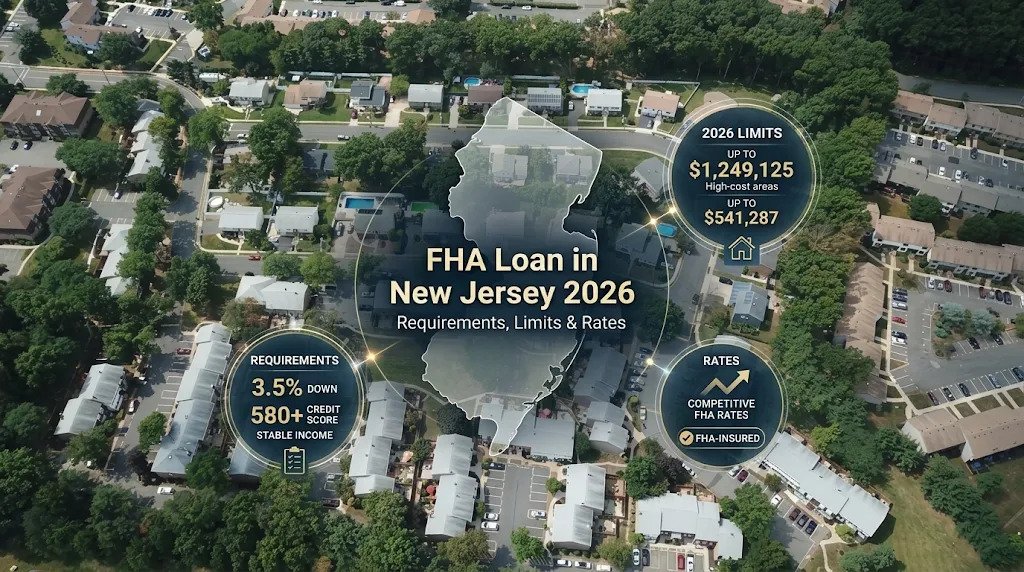
This example assumes a 580 plus credit score. If your score is between 500 and 579, the down payment becomes 10 percent, or $30,000, and the cash to close rises to about $42,000. For 2026, the FHA loan limit for a one unit home runs from a $541,287 floor to a $1,249,125 ceiling, according to HUD’s announcement of the 2026 FHA loan limits, so a $300,000 home is covered everywhere in the country.
What Goes Into Cash to Close
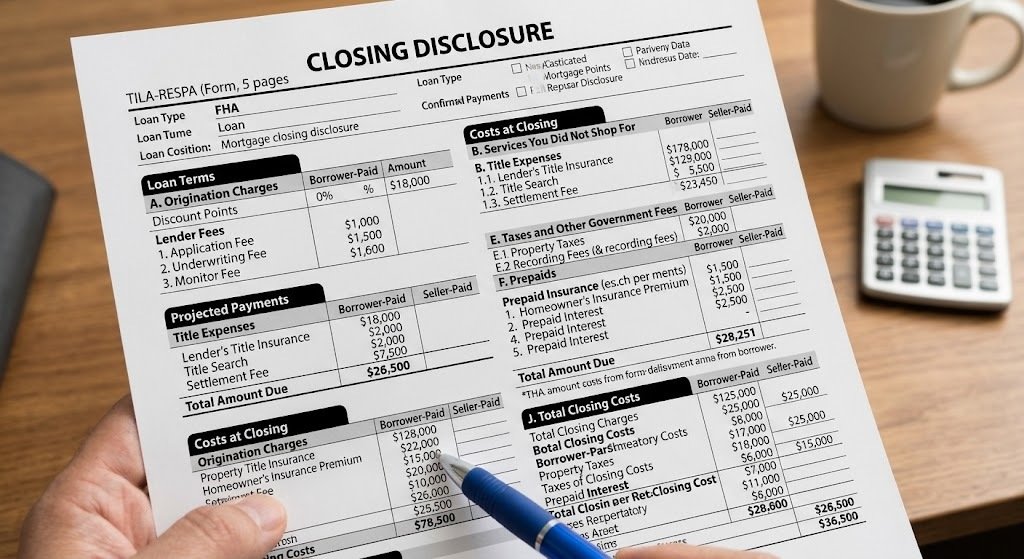
Cash to close is the number that matters most, and it has four parts. The down payment is the largest, but the other three can add up to more than the down payment itself.
Closing costs cover the services needed to complete the purchase: the appraisal, the loan origination fee, the credit report, title search and title insurance, and recording fees. On a $300,000 home these usually run from $6,000 to $15,000, or 2 to 5 percent of the price. Prepaid items are costs you pay in advance at closing: homeowners insurance for the first year, interest from the closing date to the end of the month, and the initial deposit into your escrow account, commonly another $2,000 to $4,000.
The upfront MIP is the third part, but only if you pay it in cash. Most buyers finance it, so it shows up in the loan balance rather than in cash to close. Cash reserves are not technically part of cash to close, but lenders sometimes require them, especially for borrowers with lower credit scores. Our guide to how FHA loans work for repeat buyers explains how these costs apply when you have bought before.
How to Use an Online FHA Calculator
Most online FHA calculators ask for the same inputs: home price, down payment amount or percentage, interest rate, loan term, property tax rate, homeowners insurance and your location. Enter the numbers you gathered earlier, and run the calculation more than once with different home prices.
Test the edges. Try a home price $25,000 higher and $25,000 lower than your target, and try the 10 percent down payment to see what happens if your credit score comes in lower than expected.
Read the results carefully. Some calculators show only the down payment and ignore closing costs. A good calculator shows the down payment, the upfront MIP, the monthly MIP, the closing cost estimate and the total cash to close.
Finally, compare the calculator result with a lender’s Loan Estimate once you apply. The Loan Estimate is a standardised form every lender must provide within three business days of your application.
Common Calculator Mistakes to Avoid
The most common mistake is entering the wrong credit score bracket. A buyer who guesses a score of 600 when their real score is 570 will see a 3.5 percent down payment in the calculator and a 10 percent requirement from the lender. That is a $19,500 surprise on a $300,000 home. Check your score before you calculate.
The second mistake is forgetting closing costs entirely. Some buyers save exactly the down payment and then discover they need another $9,000 to $15,000 at closing.

The third mistake is using an outdated interest rate. Rates move daily, and a rate from six months ago can make your monthly payment look hundreds of dollars lower than it really is.
The fourth mistake is ignoring the monthly MIP. FHA mortgage insurance adds about $133 a month on a $300,000 home with 3.5 percent down, and that amount stays for the life of the loan if your down payment is under 10 percent. See our article on can you have two FHA loans at once for another case where FHA rules surprise buyers.
The fifth mistake is treating a calculator result as an approval. A calculator cannot check your employment history, your debts or your credit report. It estimates numbers; only a lender can approve a loan. Use the calculator to plan and set a savings target, then talk to an FHA approved lender to confirm the real numbers with a written Loan Estimate.
Frequently Asked Questions
What does an FHA loan down payment calculator calculate?
It estimates your down payment, loan amount, upfront MIP, monthly MIP, closing costs and total cash to close.
How much down payment do I need on a $300,000 FHA loan?
With a credit score of 580 or higher, the minimum is 3.5 percent, which is $10,500. With a score of 500 to 579, the minimum is 10 percent, which is $30,000.
What is cash to close on a $300,000 FHA loan?
In our worked example, cash to close is about $22,500: a $10,500 down payment, $9,000 in closing costs and $3,000 in prepaid items, with the upfront MIP financed into the loan.
What is the upfront MIP on an FHA loan?
The upfront mortgage insurance premium is 1.75 percent of the loan amount, charged once at closing. On a $289,500 loan it is $5,066.25.
How much is the monthly MIP on a $300,000 FHA loan?
For most 30 year FHA loans, the annual MIP rate is 0.55 percent of the loan amount. On a $289,500 loan, that is about $133 per month.
Are online FHA calculators accurate?
They are accurate for the down payment and MIP, which follow fixed rules. They are only estimates for closing costs and monthly payments, which depend on your lender, your rate, your taxes and your insurance.
Can I use gift funds for my FHA down payment?
Yes. Gift funds from a family member, employer or approved programme can cover the full 3.5 percent minimum down payment, as long as the gift is documented with a gift letter and bank statements.
Does my credit score change the calculator result?
Yes, more than any other input. A score of 580 or higher gives a 3.5 percent down payment, while a score of 500 to 579 gives a 10 percent down payment.
What is the FHA loan limit for 2026?
For a one unit home, the 2026 FHA loan limit floor is $541,287 and the ceiling in high cost areas is $1,249,125.
How long does FHA mortgage insurance last?
If your down payment is less than 10 percent, annual MIP usually lasts for the life of the loan. If you put down 10 percent or more, it drops off after 11 years. You can also remove it by refinancing into a conventional loan once you have at least 20 percent equity.






4 Responses