

If you’ve been comparing home loan options and keep circling back to the same question — “Why would I choose an FHA mortgage over anything else?” — you’re not alone. FHA loans are consistently among the most popular financing paths for home buyers across Virginia, Florida, Tennessee, Georgia, and the District of Columbia, and for good reason.
The Federal Housing Administration doesn’t lend money directly. Instead, it insures loans made by approved brokers and lenders, which reduces the risk those investors take on. That reduced risk gets passed directly to borrowers in the form of more flexible qualification standards, lower down payment requirements, and competitive interest rates — even for buyers who wouldn’t qualify for a conventional loan at all.
But “flexible” doesn’t mean “for everyone.” FHA loans shine brightest in specific situations: first-time buyers still building credit history, buyers who haven’t yet saved a large down payment, or buyers recovering from past financial hardship. Understanding exactly when and why an FHA loan outperforms conventional alternatives is the key to making a confident decision.
This guide walks through eight concrete reasons borrowers choose FHA financing — with real numbers, current 2026 loan limits sourced from HUD Mortgagee Letter 2025-23, and honest comparisons so you can decide whether this path fits your situation. Every regulatory figure here is sourced and verified as of July 2026.
Reason 1: The 3.5% Down Payment Changes the Math on Homeownership
The Challenge It Solves
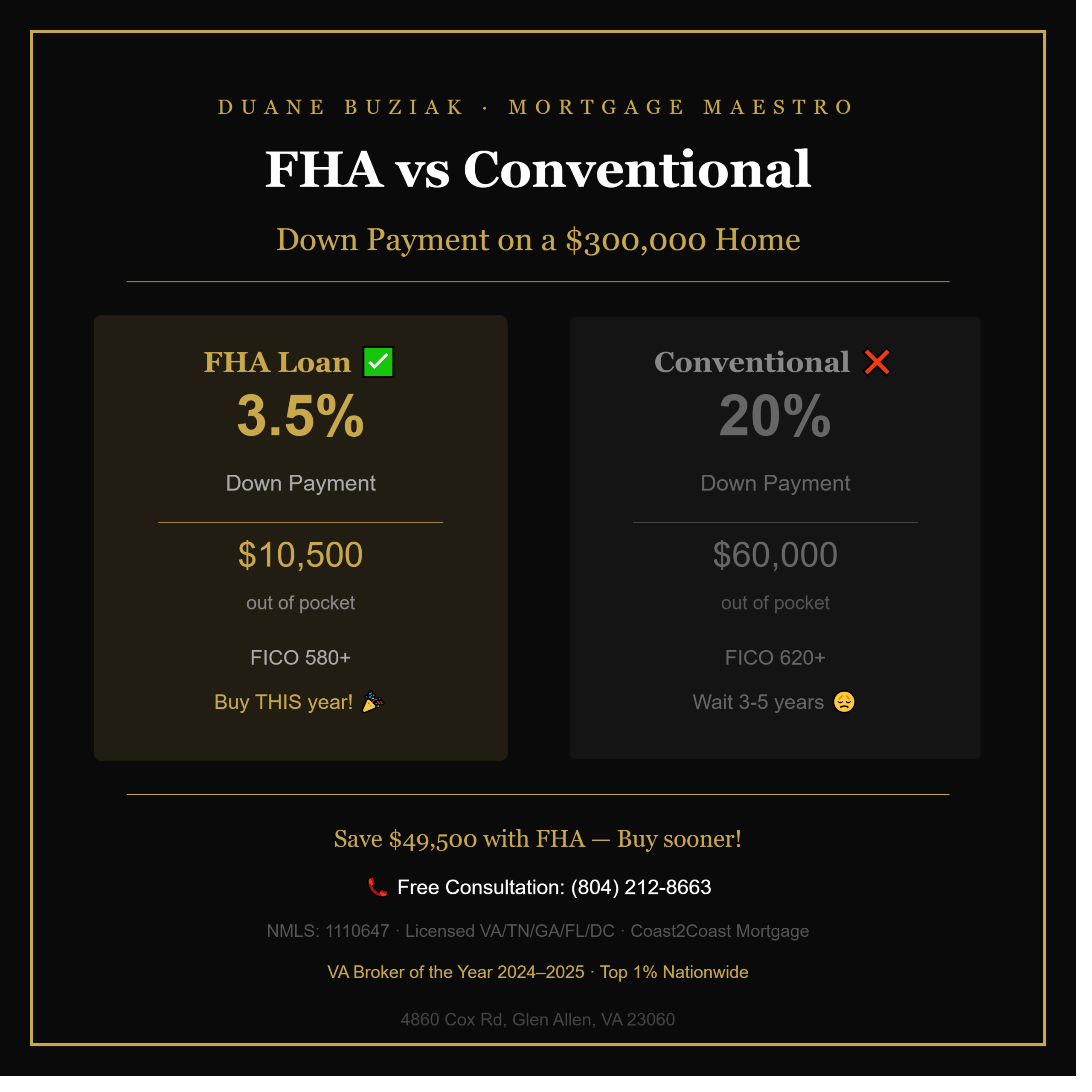
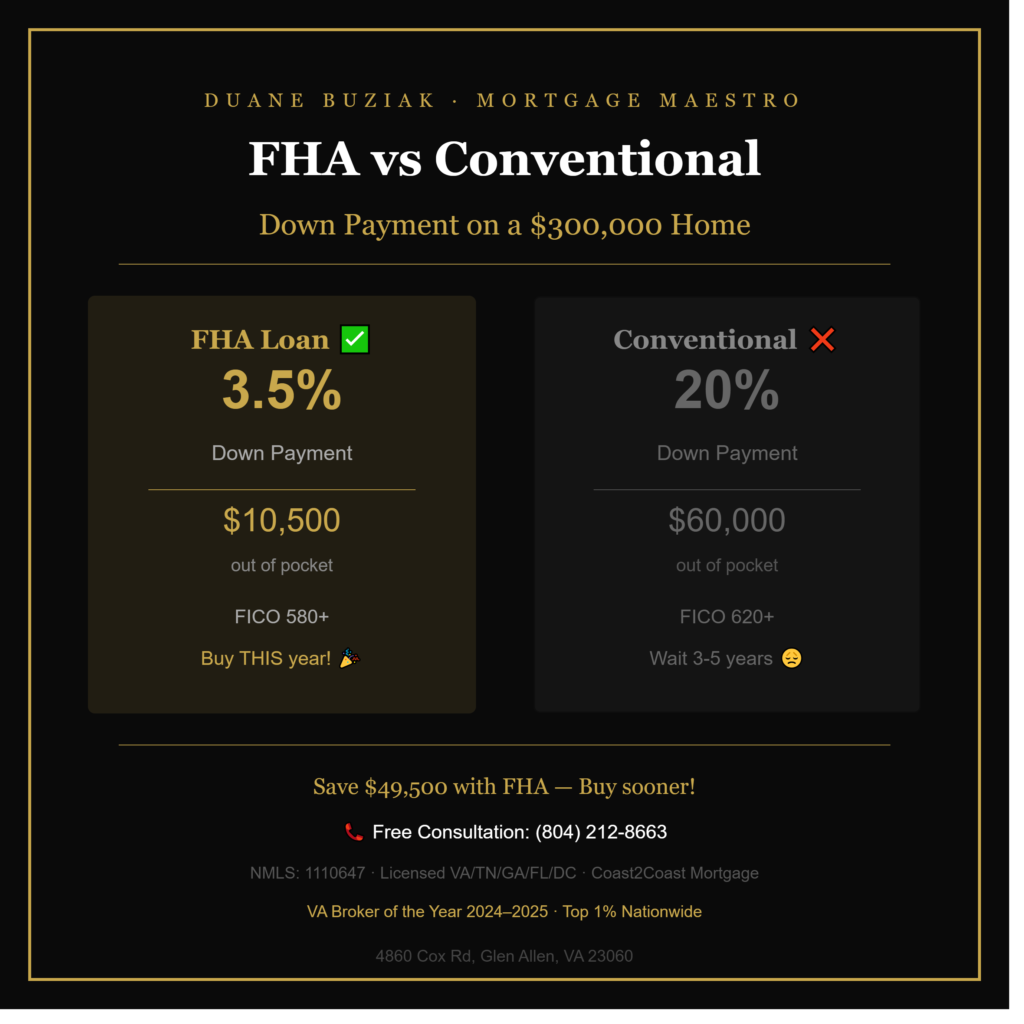
For most buyers, the down payment is the single biggest obstacle between renting and owning. Conventional loans typically require 5% down at minimum — and to avoid private mortgage insurance (PMI), you’re looking at 20%. On a $300,000 home, that’s $15,000 to $60,000 you need in cash before you even think about closing costs. For many buyers, that gap is measured in years, not months.
The Strategy Explained
FHA’s minimum down payment is 3.5% for borrowers with a FICO score of 580 or higher, per HUD Handbook 4000.1. On a $300,000 purchase in Henrico County, that’s $10,500 out of pocket — compared to $15,000 at 5% conventional or $60,000 at 20% conventional. The difference isn’t trivial. It can mean buying this year instead of waiting three to five more years to accumulate savings.
Here’s where it gets even more compelling: FHA allows 100% of the down payment to come from gift funds. And when you layer in down payment assistance programs available through Virginia Housing and other approved sources, the out-of-pocket cash requirement can drop further — without violating FHA guidelines.
Implementation Steps
- Confirm your FICO score meets the 580 threshold for 3.5% down — use Coast2Coast’s NoTouch Credit Pull (soft pull, no hard inquiry) to check without affecting your score.
- Calculate your target down payment: multiply your target purchase price by 0.035 to get the minimum FHA down payment amount.
- Ask your broker about down payment assistance programs in your county or state that can be stacked with FHA financing to reduce your out-of-pocket cash at closing.
Pro Tips
Don’t confuse “minimum down payment” with “optimal down payment.” Putting more down reduces your financed loan amount and lowers your monthly MIP cost. Run the numbers at both 3.5% and 5% to see whether the extra cash savings is worth the higher monthly payment before you commit.
Reason 2: Credit Score Flexibility That Conventional Loans Simply Don’t Match
The Challenge It Solves
Credit scores are one of the most common reasons buyers get turned away from conventional financing. A single medical collection, a period of unemployment, or a short credit history can push a FICO score into territory where conventional loan approval becomes difficult or expensive. FHA’s credit guidelines exist precisely for this situation.
The Strategy Explained
Per HUD Handbook 4000.1, FHA accepts FICO scores as low as 500 — with 10% down required at that tier. At 580 or above, the 3.5% down option opens up. Conventional loans typically require a minimum of 620 to 640 just to qualify, and risk-based pricing adjustments can significantly increase the effective rate for scores below 740.
Here’s a practical credit tier breakdown:
- Tier 1 (500–579 FICO): FHA eligible with 10% down required. Conventional financing is generally not accessible at this range.
- Tier 2 (580–619 FICO): FHA eligible with 3.5% down. Conventional access is limited with significant rate adjustments.
- Tier 3 (620–659 FICO): FHA is highly competitive here. Conventional comes with PMI and elevated rates.
- Tier 4 (660–739 FICO): Both products are competitive. A side-by-side comparison is essential.
- Tier 5 (740+ FICO): Conventional may win on the MIP elimination timeline.
Implementation Steps
- Get your actual FICO score using Coast2Coast’s NoTouch Credit Pull — a soft inquiry that doesn’t affect your score.
- Map your score to the tier table above to understand which products you can access.
- If your score is in Tier 3 or Tier 4, request a side-by-side FHA vs. conventional comparison from your broker.
Pro Tips
Even a 20-point score improvement can move you between tiers and meaningfully change your options. Before applying, ask your broker whether a rapid rescore or targeted credit action could bump your score enough to unlock better terms — sometimes a single account paydown accomplishes this in 30 days or less.
Reason 3: Government Backing Drives Competitive Rates Even at Lower Credit Scores
The Challenge It Solves
One of the most persistent myths about FHA loans is that they carry higher interest rates than conventional loans. The reality is more nuanced — and for borrowers in the 580–660 FICO range, FHA often delivers a meaningfully lower rate than what conventional pricing would produce for the same borrower.
The Strategy Explained
Because FHA loans are government-backed by the Federal Housing Administration, wholesale investors price them at lower risk than uninsured conventional loans with similar borrower profiles. The government guarantee absorbs a significant portion of default risk, which allows investors to offer competitive rates even when the borrower’s credit score would trigger aggressive risk-based pricing adjustments on a conventional product.
There is an important trade-off to understand: FHA’s competitive rate comes paired with mortgage insurance premiums (MIP) that conventional PMI does not always match in structure or duration. The next section addresses that trade-off in full detail with real numbers.
Implementation Steps
- When comparing loan options, always compare total monthly payment (P&I + MIP or PMI + taxes + insurance), not just the interest rate headline.
- Ask your broker to pull live FHA wholesale pricing across multiple investors.
- Request the Annual Percentage Rate (APR) alongside the note rate for both FHA and conventional options.
Pro Tips
Rate comparisons are most useful when done at the same moment in time with the same lock period. Understanding the factors that control your mortgage rate gives you a competitive advantage that a retail lender quoting from a single rate sheet simply cannot replicate.
Reason 4: Understanding MIP — The Real Cost You Must Calculate Before You Decide
The Challenge It Solves
FHA mortgage insurance is the most misunderstood element of FHA financing — and the most important one to get right. Transparency here is non-negotiable.
The Strategy Explained
FHA mortgage insurance has two components:
Upfront Mortgage Insurance Premium (UFMIP): A flat 1.75% of the base loan amount, per HUD Mortgagee Letter 2015-01. Typically financed into the loan.
Annual MIP: For a 30-year term, LTV above 95%, loan amount at or below $726,200 — the annual MIP rate is 0.55%, per HUD Mortgagee Letter 2023-05.
Worked Example — $300,000 Purchase in Henrico County, Virginia:
- Down payment: $10,500 (3.5%)
- Base loan amount: $289,500
- UFMIP: $5,066.25 (financed into loan)
- Financed loan amount: $294,566.25
- Annual MIP: $132.69/month
- Property tax (Henrico County $0.85/$100): $212.50/month
Implementation Steps
- Identify which MIP tier applies to your specific loan based on term, LTV, and loan amount.
- Build a 7-year and 10-year total cost comparison between FHA and conventional.
- Ask your broker to model both scenarios with actual current rates.
Pro Tips
If you put 10% or more down on an FHA loan, annual MIP cancels after 11 years rather than persisting for the life of the loan. Run both scenarios before deciding on your down payment amount.
Reason 5: Higher Debt-to-Income Tolerance Opens Doors Conventional Financing Closes
The Challenge It Solves
Student loans, car payments, credit card minimums — many buyers carry recurring debt that pushes their debt-to-income ratio above conventional underwriting thresholds. This is one of the most common reasons qualified, employed buyers get turned away from conventional loans.
The Strategy Explained
FHA’s DTI guidelines, per HUD Handbook 4000.1, allow a standard back-end DTI of 43%. With qualifying compensating factors, FHA permits DTI ratios above 50%. Accepted compensating factors include verified residual income, minimal payment shock, and documented cash reserves.
Implementation Steps
- Calculate your current back-end DTI: add all monthly minimum debt obligations and divide by gross monthly income.
- Estimate your projected housing payment, add to existing debt, and divide by gross income for total projected DTI.
- If projected DTI falls between 43% and 50%, ask your broker about compensating factors.
Pro Tips
Student loan DTI treatment is a nuanced area where FHA and conventional guidelines diverge. FHA has specific rules for income-driven repayment (IDR) plans that can be more favorable in some scenarios. Make sure your broker is calculating it correctly under current FHA guidelines.
Reason 6: The 2026 FHA Loan Limits Are Higher Than Most Buyers Expect
The Challenge It Solves
Many buyers assume FHA is only suitable for modest, entry-level home prices. The 2026 numbers tell a different story.
The Strategy Explained
The 2026 FHA loan limits, per HUD Mortgagee Letter 2025-23:
- 1-unit: $541,287 floor / $1,249,125 ceiling
- 2-unit: $693,050 floor / $1,599,375 ceiling
- 3-unit: $837,700 floor / $1,933,200 ceiling
- 4-unit: $1,041,125 floor / $2,402,625 ceiling
Virginia contains several high-cost areas where limits exceed the national floor — including Northern Virginia and the Washington DC metro area.
Implementation Steps
- Look up the FHA loan limit for your specific county at hud.gov before ruling out FHA based on price assumptions.
- If considering a 2–4 unit property, ask your broker to model the FHA multi-unit scenario with rental income included.
- Confirm your target purchase price falls within the applicable limit for your county and unit count.
Pro Tips
Loan limits are set at the county level, not the state level. Always verify the specific county limit rather than assuming a statewide number applies.
Reason 7: Gift Funds, Seller Concessions, and Assumability — Three Advantages Most Buyers Overlook
The Challenge It Solves
Beyond the headline features, FHA has three structural advantages that rarely get discussed but can meaningfully change your cash-at-closing picture and the long-term value of your loan.
The Strategy Explained
Gift Funds: Per HUD Handbook 4000.1, 100% of the FHA down payment may come from acceptable gift sources including family members, employers, charitable organizations, and government entities.
Seller Concessions: FHA allows sellers to contribute up to 6% of the sale price toward the buyer’s closing costs. In a market where closing costs represent 2–4% of the purchase price, a negotiated seller concession can eliminate most or all out-of-pocket closing expenses.
Assumability: FHA loans are assumable — a future buyer can take over your existing loan at its original interest rate, per HUD Handbook 4000.1 Section III.A.2. In a rising-rate environment, a below-market FHA rate becomes a tangible asset attached to your property.
Implementation Steps
- If using gift funds, document the gift with a signed gift letter meeting HUD requirements.
- When negotiating your purchase contract, include a seller concession request up to the 6% FHA maximum.
- Keep your FHA loan documents accessible after closing — your assumable rate is a marketing asset when you sell.
Pro Tips
Assumability is underutilized because most sellers and agents don’t think to advertise it. If you hold an FHA loan at a rate below prevailing market rates, make sure your future listing agent understands how to position it.
Reason 8: The Broker Advantage — How You Access FHA Matters as Much as Whether You Choose It
The Challenge It Solves
Two borrowers with identical profiles can receive meaningfully different FHA loan terms depending on whether they apply through a mortgage broker or a retail lender.
The Strategy Explained
Retail lenders originate FHA loans from a single product shelf with proprietary overlays and pricing. Coast2Coast Mortgage LLC, as an independent broker, accesses 500+ wholesale lenders simultaneously — meaning multiple FHA wholesale pricing sheets are compared for your specific scenario, not a single in-house rate.
The NoTouch Credit Pull is a direct example of this advantage. Coast2Coast can pre-qualify you using a soft credit inquiry that does not affect your score. Retail lenders — including First Heritage Mortgage, First Home Mortgage, ALCOVA Mortgage, and Rocket Mortgage — typically require a hard pull before they can provide a pre-qualification.
Implementation Steps
- Before applying anywhere, get your NoTouch pre-qualification through Coast2Coast — a soft pull with no credit impact.
- If you’ve already received a retail quote, bring it to Coast2Coast for a side-by-side comparison using live wholesale pricing.
- Ask specifically about overlay restrictions on minimum FICO and DTI caps.
Pro Tips
Broker access to wholesale pricing isn’t just about rate — it’s about options. When one investor’s overlay creates a problem, a broker has alternatives. A retail lender has one answer: yes or no.
Putting It All Together: Is an FHA Mortgage Right for You?
Choosing an FHA mortgage isn’t about settling — it’s about matching the right tool to your specific financial situation. The calculation that matters isn’t just the interest rate. It’s total cost of ownership: your down payment, your monthly MIP, your property tax at your actual county’s rate, and your realistic path to equity.
Here’s your prioritized implementation path:
- Get your actual FICO score with a NoTouch soft pull — no credit impact, immediate clarity.
- Calculate your projected DTI using your current monthly obligations and a target purchase price.
- Request a side-by-side FHA vs. conventional comparison from Coast2Coast using live wholesale pricing.
- Review the full TCO picture: down payment, UFMIP, monthly MIP, county property tax, and MIP duration timeline.
Ready to Find Out If FHA Is Right for You?
The next step is a conversation, not a commitment.
📞 Call/Text: (804) 212-8663
📧 Email: duane@coast2coastml.com
📍 Office: 4860 Cox Rd, Glen Allen, VA 23060
🌐 Website: www.DuaneBuziakMortgageMaestro.com
📋 NMLS: #1110647 | Licensed in VA, TN, GA, FL, DC