


FHA Loan Closing Costs Guide: What to Expect before you sign your final mortgage documents. FHA closing costs are the fees, prepaid expenses, and mortgage related charges connected with completing your home purchase. They are separate from your down payment.
As a general planning range, FHA closing costs often fall around 2% to 6% of the purchase price or loan related costs, although your actual amount can be higher or lower depending on the property, lender, location, taxes, insurance, and services you choose. Several of the largest expenses can also be reduced through seller contributions, lender credits, gift funds, or financing the upfront FHA mortgage insurance premium.
The important point is this: your closing costs are not the same as the cash you ultimately need to bring to closing. Your cash to close can be reduced by your earnest money deposit, seller credits, lender credits, eligible assistance, and certain financed charges.

How Much Are FHA Loan Closing Costs in 2026?
There is no single FHA closing cost amount because every transaction is different. A practical planning range is about 2% to 6%, but the percentage should not be treated as an FHA mandated fee.
For example, on a $300,000 home, 2% to 6% represents approximately $6,000 to $18,000. Your actual bill depends on the loan amount, property taxes, insurance, title services, lender charges, prepaid interest, discount points, and local recording or transfer fees.
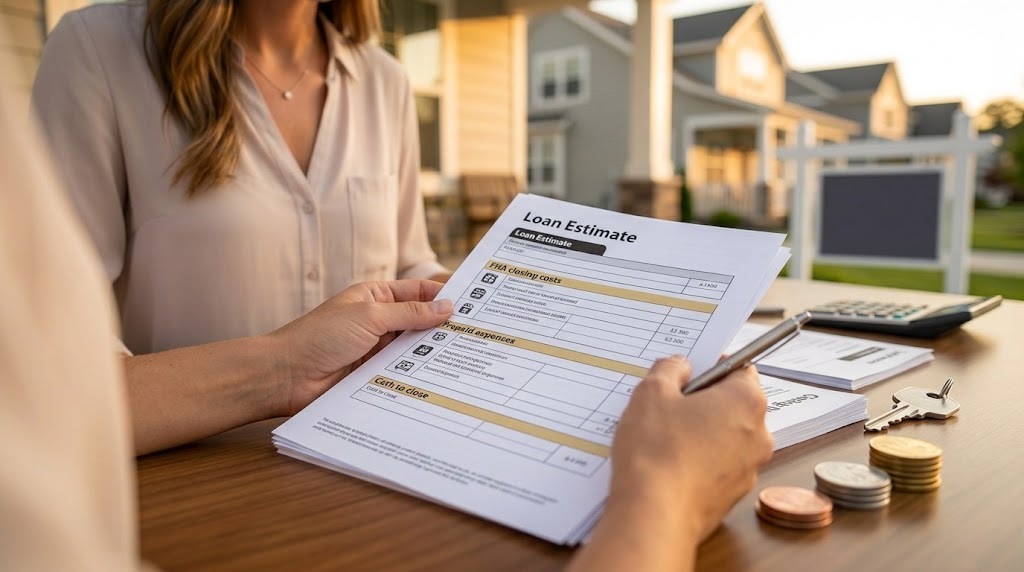
Your lender’s Loan Estimate is much more useful than a generic percentage. The Consumer Financial Protection Bureau says lenders generally provide this three page form within three business days after receiving the required application information. It shows estimated loan terms, payments, and closing costs.
Closing Costs vs. Cash to Close
These terms are easy to confuse.
Closing costs are the charges associated with obtaining the mortgage and completing the purchase.
Cash to close is the amount you actually need to provide at closing after credits, deposits, adjustments, and other offsets are considered.
For example, suppose your transaction has:
- $9,000 in closing costs
- $10,500 down payment
- $5,000 earnest money already deposited
- $3,000 seller credit
Your cash requirement would not simply be $19,500. The deposit and seller credit reduce the amount still needed.
The CFPB’s Loan Estimate and Closing Disclosure provide a standardized way to see how these amounts are calculated.
What Does an FHA Loan Closing Costs Guide Include?
FHA closing expenses generally fall into several categories. Understanding each one makes your Loan Estimate much easier to review.
1. Upfront Mortgage Insurance Premium
One of the most important FHA specific charges is the Upfront Mortgage Insurance Premium, or UFMIP.
For most FHA forward mortgages, the UFMIP is 1.75% of the base loan amount. HUD confirms that this premium may be collected at closing and can generally be financed into the mortgage rather than paid entirely in cash.
For example, if your base FHA loan amount is $290,000:
$290,000 × 1.75% = $5,075 UFMIP
If financed, that $5,075 is added to the loan balance instead of being paid fully from your bank account at closing.
However, financing UFMIP does not make it free. A larger loan balance generally means more interest paid over time.
2. Lender Fees
Lender charges may include:
- Loan origination fees
- Underwriting fees
- Processing fees
- Document preparation fees
- Credit report fees
- Discount points
- Rate lock related charges, when applicable
Discount points are optional in many transactions. One point generally equals 1% of the loan amount. The benefit is a potentially lower interest rate, so compare the upfront cost with the expected monthly savings.
3. FHA Appraisal
The property must meet FHA requirements, and an FHA appraisal is part of the mortgage process.
The appraisal determines whether the property’s value supports the transaction and whether it meets applicable FHA property requirements. The appraisal fee is typically paid by the borrower unless another party legally covers it.
Do not confuse an appraisal with a home inspection. An appraisal is primarily connected to the lender’s collateral and FHA requirements. A separate inspection is designed to help the buyer understand the home’s condition.
4. Title and Settlement Charges
Title related costs can include:
- Title search
- Lender’s title insurance
- Owner’s title insurance, where purchased
- Settlement or closing services
- Attorney fees in states or transactions where applicable
- Notary or recording related charges
These expenses vary significantly by location. Some services may also be available from providers you can shop for.
5. Prepaid Expenses and Escrow
Not every amount shown at closing is technically a lender fee.
You may need to prepay items such as:
- Homeowners insurance
- Property taxes
- Prepaid mortgage interest
- Initial escrow deposits
- Certain other property related charges
This distinction matters because a buyer might look at a large cash to close figure and assume the lender is charging all of it as a fee.
The CFPB explains that the Loan Estimate and Closing Disclosure separate loan costs, other costs, prepaid items, and escrow related amounts.
Can the Seller Pay FHA Closing Costs?
Yes. FHA rules allow interested parties to contribute up to 6% of the sales price toward eligible borrower costs, including certain closing costs, prepaid items, discount points, and UFMIP. HUD’s current FHA Handbook 4000.1 confirms the 6% interested party contribution limit.
For example, on a $300,000 purchase:
$300,000 × 6% = $18,000 maximum contribution
But that does not mean you automatically receive $18,000 in cash.
The contribution must be used for eligible costs. Contributions that exceed the borrower’s actual eligible costs can create an inducement to purchase issue rather than simply becoming extra money in the buyer’s pocket.
This is why negotiating a seller credit should be based on your actual estimated costs rather than automatically asking for the maximum.
A Practical Example
Imagine a buyer purchasing a $300,000 home with an FHA mortgage.
Their estimated eligible costs total $10,500.
The seller agrees to a $12,000 credit.
The buyer should not assume they will receive the unused $1,500 as cash. The credit is generally applied to eligible transaction costs under FHA and mortgage rules.
This is one of the most useful points to understand when negotiating seller assistance: a credit is designed to offset eligible costs, not create extra cash back to the buyer.
How Can You Reduce FHA Closing Costs?
You may have several ways to reduce the amount you need to bring to closing.
Seller Credits
A seller credit can cover eligible closing expenses, prepaid costs, discount points, and other permitted charges within FHA limits.
If you are negotiating an offer, compare the value of a seller credit with a lower purchase price. In a transaction where cash is the main obstacle, a credit may be more useful than a small price reduction.
Lender Credits
A lender may offer credits toward closing costs. However, lender credits can come with a higher interest rate.
The CFPB specifically recommends understanding the tradeoff between lender credits and the interest rate because the upfront savings can increase your long term borrowing cost.
Ask the lender to show you both options:
Option A: Lower rate + higher closing costs
Option B: Higher rate + lender credit
Then compare the total cost over the period you expect to keep the mortgage.
Gift Funds
Eligible gift funds can help cover required funds for an FHA transaction when properly documented.
A gift is not the same as an undocumented transfer from a family member. Your lender will generally need documentation showing the source and terms of the funds.
State and Local Assistance
Some state housing agencies, local governments, and nonprofit programs offer assistance for qualified homebuyers.
Eligibility can depend on income, location, property type, first time buyer status, and other requirements.
Because these programs change, check the current program rules rather than relying on an old article or social media post.
Shop for Certain Services
Your Loan Estimate identifies services you may be able to shop for.
Depending on the transaction and location, comparing providers for eligible services can reduce costs without changing the mortgage itself.
The CFPB’s official Loan Estimate resources explain how consumers can review and compare these charges.
Can FHA Closing Costs Be Rolled Into the Loan?
Some costs can be financed, but you generally cannot simply add every closing cost to the FHA mortgage.
The clearest example is FHA UFMIP. The 1.75% upfront premium can generally be financed into the FHA loan.
Other closing costs may instead be covered through:
- Seller contributions
- Lender credits
- Gift funds
- Down payment or closing cost assistance
- Your own funds
Another approach is premium pricing, where the lender provides a credit in exchange for a higher interest rate. This can reduce the amount you pay upfront, but it may increase the cost of the mortgage over time.
This is why “zero closing cost” does not necessarily mean “free.” Always compare the interest rate and total loan cost.
What Should You Check Before FHA Closing?
Your final review should happen before you arrive at the closing table.
The CFPB requires the lender to provide the Closing Disclosure at least three business days before closing in covered mortgage transactions. That gives you time to compare the final figures with your Loan Estimate.
Check these items carefully:
- Loan amount: Does it match what you expected?
- Interest rate: Is the rate correct?
- Monthly payment: Does the payment include the expected taxes and insurance?
- Origination charges: Did any lender fees change?
- Seller credits: Are negotiated credits shown correctly?
- Lender credits: Are promised credits listed?
- Prepaid items: Do the tax and insurance amounts make sense?
- Cash to close: Is the final amount reasonable compared with your Loan Estimate?
- UFMIP: Is it financed or paid upfront as planned?
- Adjustments: Are deposits, prorated taxes, or other credits properly reflected?
The CFPB recommends checking that closing costs and cash to close match your most recent Loan Estimate and asking the lender to explain significant differences.

FHA Closing Costs Example for a $300,000 Home
Here is an illustrative example to show how the pieces can fit together.
Assume:
- Purchase price: $300,000
- FHA down payment at 3.5%: $10,500
- Base FHA loan: $289,500
- UFMIP at 1.75%: $5,066.25
- Other estimated closing and prepaid costs: $9,500
- Seller credit: $8,000
- Earnest money already paid: $5,000
The UFMIP could be financed rather than paid from cash.
The $8,000 seller credit could reduce eligible closing expenses, while the $5,000 deposit would also reduce the remaining amount due at closing.
The important lesson is that a buyer should not simply calculate:
3.5% down + 2% to 6% closing costs = cash needed
Instead, calculate the complete transaction using the Loan Estimate, expected credits, deposits, financed UFMIP, and prepaid expenses.
That approach gives you a much more realistic picture of your cash requirement.
How to Prepare for FHA Closing Costs
Start preparing before you make an offer.
Step 1: Get Preapproved
Ask the lender for an estimated cash to close, not just a monthly payment.
Step 2: Request a Detailed Loan Estimate
Review the individual charges instead of focusing only on the total.
Step 3: Ask Which Services You Can Shop For
Compare eligible providers where permitted.
Step 4: Discuss Seller Credits
If you need help with upfront costs, discuss a seller credit with your real estate agent before finalizing the purchase contract.
Step 5: Compare Lender Credit Options
Ask the lender to calculate the rate and closing cost difference.
Step 6: Keep Extra Cash Available
Do not spend every dollar of your available savings on the down payment. Moving costs, repairs, utility deposits, furnishings, and unexpected expenses can arrive immediately after closing.
Step 7: Review the Closing Disclosure
Use the three business day review period to identify errors or unexpected changes.
Final Thoughts on FHA Loan Closing Costs
FHA closing costs are easier to manage when you separate the headline percentage from the actual cash to close.
Your costs can include UFMIP, lender charges, appraisal and title services, prepaid interest, property taxes, insurance, and escrow deposits. The good news is that FHA financing provides several ways to reduce your upfront burden, including eligible seller contributions, FHA Lender Credits, gift funds, assistance programs, and financing the upfront mortgage insurance premium.
The best strategy is not simply to find the lowest closing cost. It is to compare the interest rate, upfront cash, monthly payment, and total borrowing cost together.
Before closing, compare your Loan Estimate with the final Closing Disclosure and ask your lender to explain anything that changed. The CFPB provides official examples and explanations of both forms.
If you are planning to use an FHA mortgage in 2026, use your lender’s personalized estimate to determine how much cash you are likely to need and which costs may be covered by available credits or assistance.
FHA Loan Closing Costs FAQ
How much are FHA loan closing costs?
FHA closing costs commonly fall in the range of about 2% to 6%, but the actual amount varies by lender, location, loan amount, property taxes, insurance, title charges, prepaid expenses, and other transaction costs.
Can the seller pay FHA closing costs?
Yes. FHA rules generally allow interested parties to contribute up to 6% of the sales price toward eligible borrower costs, including certain closing costs, prepaid items, discount points, and UFMIP. The contribution cannot simply become unused cash for the buyer.
Can FHA closing costs be rolled into the mortgage?
Some costs can be financed. Most notably, the FHA Upfront Mortgage Insurance Premium can generally be financed into the loan. Other closing costs typically require cash, credits, gift funds, or approved assistance unless another permitted financing structure covers them.
What is the FHA Upfront Mortgage Insurance Premium?
The FHA Upfront Mortgage Insurance Premium is generally 1.75% of the base loan amount for most FHA forward mortgages. It can usually be financed into the mortgage, although doing so increases the loan balance.
When will I know my final FHA closing costs?
Your lender generally provides a Loan Estimate within three business days after receiving the required application information. A Closing Disclosure is generally provided at least three business days before closing, giving you time to review the final loan terms and costs.
How can I lower FHA closing costs?
You may be able to reduce your upfront costs through seller contributions, lender credits, eligible gift funds, state or local assistance programs, shopping for permitted services, or financing the upfront mortgage insurance premium. Compare the long term cost of each option before choosing one.