


Mortgage programs for first-time home buyers can make purchasing a home more affordable by offering lower down payments, flexible qualification requirements, and financial assistance. However, choosing the right mortgage depends on your credit score, income, savings, location, and long-term financial goals.
Buying your first home is a major financial decision. Many buyers believe they need a large down payment or perfect credit before they can qualify for a mortgage. Fortunately, several financing options are available in the United States to help eligible buyers become homeowners.
From FHA loans and conventional mortgages to VA and USDA financing, each program has different benefits and eligibility requirements. Some state and local programs also provide down payment or closing cost assistance.
In this guide, you will learn about the best mortgage options, how to qualify, where to find homebuyer assistance, and how to compare loan offers before making a decision.
What Are the Best Mortgage Programs for First-Time Home Buyers?
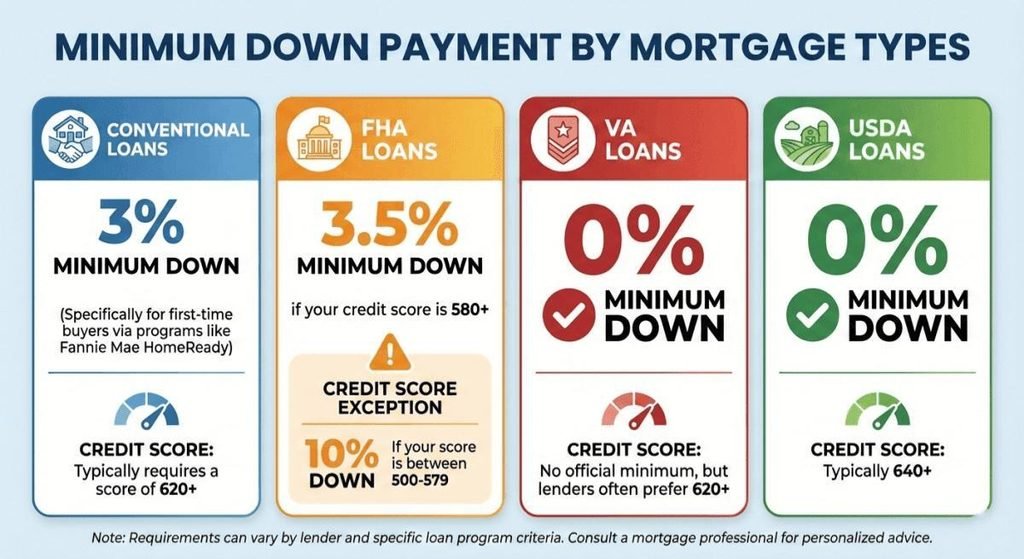
The best mortgage program depends on your financial situation and eligibility. FHA loans may suit buyers who need flexible credit requirements, conventional loans may work well for buyers with stronger credit, and VA or USDA loans can offer zero-down-payment options to eligible borrowers.
Here are six mortgage options worth exploring.
1. FHA Loans
Federal Housing Administration (FHA) loans are popular among first-time buyers because they offer relatively flexible credit requirements and low down payments.
FHA loans are insured by the Federal Housing Administration, which is part of the U.S. Department of Housing and Urban Development (HUD). Approved private lenders provide the actual mortgage.
Key benefits include:
- Down payments as low as 3.5% for eligible borrowers.
- Flexible credit qualification guidelines.
- Financing options for eligible one-to-four-unit properties.
- Opportunities for buyers with limited savings.
FHA loans require mortgage insurance premiums (MIP), which increase the overall cost of borrowing. Buyers should compare the upfront and ongoing insurance costs before choosing this option.
Who should consider an FHA loan?
First-time buyers with limited savings or credit challenges may benefit from exploring FHA financing.
2. Conventional Loans
Conventional mortgages are not insured by the federal government. Many are backed by Fannie Mae or Freddie Mac and are offered through participating private lenders.
Some conventional programs allow eligible first-time buyers to purchase a home with as little as 3% down.
Popular options include:
- Conventional 97
- Fannie Mae HomeReady
- Freddie Mac Home Possible
- Freddie Mac HomeOne
Key benefits include:
- Low down payment options.
- Flexible financing features for eligible borrowers.
- Private mortgage insurance (PMI) that may be cancellable when sufficient home equity is reached, subject to requirements.
- Different loan terms and interest rate options.
Conventional loans may be attractive to buyers with stronger credit profiles who want to compare mortgage insurance costs and long-term affordability.
For example, Fannie Mae’s HomeReady program offers eligible borrowers down payments as low as 3%, with income and other qualification requirements.
3. VA Loans
VA loans are backed by the U.S. Department of Veterans Affairs and are available to eligible veterans, active-duty service members, and certain surviving spouses.
One of the biggest advantages is that eligible borrowers may purchase a home without making a down payment.
Key benefits include:
- No down payment required in many eligible transactions.
- No monthly private mortgage insurance (PMI).
- Competitive financing options.
- Flexible qualification features.
A VA funding fee may apply unless the borrower qualifies for an exemption. Lenders may also have their own credit and underwriting requirements.
Who should consider a VA loan?
Eligible military members, veterans, and surviving spouses should compare VA financing before selecting another mortgage option.
4. USDA Loans
USDA loans are designed to support eligible homebuyers purchasing properties in qualifying rural and some suburban areas.
The U.S. Department of Agriculture offers a guaranteed loan program through approved lenders. Eligible borrowers may qualify for 100% financing, meaning no down payment is required.
Key benefits include:
- No down payment for eligible borrowers.
- Financing for qualifying rural properties.
- Income-based eligibility requirements.
- Options for low- and moderate-income households.
However, the property must meet location requirements, and household income must fall within the applicable limits.
Buyers should use the official USDA property and income eligibility resources to check whether a particular home qualifies.
5. State First-Time Homebuyer Programs
Many Home Buyer Programs states operate housing finance agencies that provide mortgage options and assistance to eligible homebuyers.
These programs may offer:
- Below-market mortgage rates.
- Down payment assistance.
- Closing cost assistance.
- Special financing options for eligible professions.
- Homebuyer education courses.
For example, the Tennessee Housing Development Agency offers its Great Choice Home Loan program and other assistance options for eligible buyers.
Program requirements, funding availability, income limits, and purchase price restrictions vary by state.
How can you find programs in your state?
Start by searching for your state’s housing finance agency. You can also explore the National Council of State Housing Agencies directory to locate your state housing agency.
6. Special Mortgage and Homebuyer Assistance Programs
Some buyers may qualify for additional programs based on their occupation, income, location, or personal circumstances.
Examples include:
Good Neighbor Next Door
HUD offers eligible law enforcement officers, teachers, firefighters, and emergency medical technicians an opportunity to purchase certain qualifying properties at a substantial discount. Properties and eligibility conditions are limited.
Housing Choice Voucher Homeownership Program
Certain eligible Housing Choice Voucher participants may use their assistance toward homeownership expenses if their local public housing agency operates the program and they meet its requirements.
Homebuyer Education Programs
Some mortgage and assistance programs require buyers to complete an approved homebuyer education course. These courses explain budgeting, mortgage payments, closing costs, and homeownership responsibilities.
Always check the current availability and eligibility rules before relying on any special program.
How Do You Qualify for First-Time Home Buyer Mortgage Programs?
Although each mortgage program has different requirements, lenders generally review several important financial factors before approving a home loan.
Credit Score and Credit History
Your credit score helps lenders understand how you manage borrowed money.
A higher credit score may improve your chances of receiving favorable mortgage terms. However, some government-backed programs offer more flexible credit requirements.
For example, FHA guidelines generally allow a 3.5% minimum down payment for borrowers with qualifying credit scores of 580 or higher. Additional lender requirements may apply.
Before applying, review your credit reports, check for errors, and work on paying bills on time.
Income and Employment History
Mortgage lenders review your income to determine whether you can afford monthly housing payments.
You may need to provide:
- Recent pay stubs.
- W-2 forms or tax returns.
- Bank statements.
- Employment information.
- Additional income documentation when applicable.
Self-employed borrowers may need additional documentation to verify their income.
Debt-to-Income Ratio
Your debt-to-income ratio (DTI) compares your monthly debt payments with your gross monthly income.
For example, if your gross monthly income is $6,000 and your monthly debt payments total $2,100, your DTI is 35%.
Lenders consider DTI alongside credit history, savings, loan type, and other financial factors. There is no single DTI limit that applies to every mortgage program.
Down Payment and Savings
Your down payment is the amount you contribute toward purchasing the property.
Some programs allow low or zero down payments for eligible borrowers. However, buyers should also prepare for closing costs, moving expenses, property taxes, insurance, and possible repairs.
Having additional savings can help you manage unexpected expenses after moving into your new home.
How Can You Find the Right Mortgage Assistance Program?

Finding a mortgage program is only the first step. You also need to determine whether you qualify and understand how the assistance affects your overall borrowing costs.
Follow these steps to research available options.
Step 1: Check Your State Housing Finance Agency
Visit your state’s official housing finance agency website.
Look for information about first-time buyer loans, down payment assistance, income limits, and participating lenders.
Some programs are available only in specific counties or cities.
Step 2: Explore Down Payment Assistance
Down payment assistance programs can help eligible buyers cover some upfront homebuying expenses.
Common assistance types include:
- Grants: Financial assistance that generally does not need to be repaid, subject to program conditions.
- Forgivable loans: Loans that may be forgiven after meeting specific occupancy or other requirements.
- Deferred-payment loans: Loans that may not require monthly payments but become repayable under specified conditions.
- Low-interest second mortgages: Additional financing that helps cover down payment or closing costs.
Read the program terms carefully. Assistance is not automatically free money, and some programs require repayment when you sell, refinance, or move.
Step 3: Compare Multiple Mortgage Lenders
Contact at least three mortgage lenders to explore your options.
Ask about:
- Available mortgage programs.
- Interest rates and annual percentage rates (APR).
- Down payment requirements.
- Mortgage insurance costs.
- Closing costs and lender fees.
- Eligibility for assistance programs.
Request official Loan Estimates when you are ready to compare specific loan offers.
The Consumer Financial Protection Bureau (CFPB) explains how borrowers can compare mortgage offers and understand loan costs.
Step 4: Review Program Eligibility
Before submitting an application, confirm that you meet the program’s requirements.
Some programs consider:
- Household income.
- Credit history.
- Property location.
- Purchase price.
- First-time buyer status.
- Completion of a homebuyer education course.
Many programs define a first-time homebuyer as someone who has not owned a primary residence during the previous three years. However, definitions vary, so check the specific program rules.
Step 5: Get Preapproved and Prepare Your Documents
Once you identify suitable mortgage options, speak with a participating lender about preapproval.
A lender may review your income, assets, credit history, and outstanding debts.
Preapproval can help you understand your potential borrowing range before making an offer on a property. It is not a final loan approval, and your financial circumstances and the property must still meet underwriting requirements.
How Do You Choose the Best Mortgage Program?
The lowest down payment does not always mean the cheapest mortgage.
Compare the total cost of each option rather than focusing only on the amount required upfront.
Consider these important factors:
| Comparison factor | What to check |
|---|---|
| Interest rate | How much interest will you pay? |
| APR | What is the overall annual borrowing cost? |
| Down payment | How much money must you contribute? |
| Mortgage insurance | Is PMI or MIP required? |
| Closing costs | What fees will you pay at closing? |
| Assistance terms | Is assistance repayable or forgivable? |
| Loan term | How long will you make payments? |
A Simple Example of Comparing Mortgage Options
Imagine two eligible first-time buyers are considering a $250,000 home.
- Buyer A chooses an FHA loan with a 3.5% down payment, equal to $8,750.
- Buyer B chooses a conventional mortgage with a 3% down payment, equal to $7,500.
Buyer B contributes $1,250 less toward the down payment.
However, that does not automatically make the conventional mortgage the better option. The interest rate, mortgage insurance, closing costs, and assistance eligibility may change the total cost.
This example shows why buyers should compare complete Loan Estimates instead of selecting a mortgage based on the down payment alone.
What Mistakes Should First-Time Home Buyers Avoid?
Choosing a mortgage without understanding its conditions can create financial difficulties later.
Avoid these common mistakes:
- Choosing only by down payment: A smaller down payment may come with higher monthly costs.
- Ignoring mortgage insurance: Understand whether PMI or MIP applies and how long it may be required.
- Not comparing lenders: Different lenders may offer different rates, fees, and loan terms.
- Overlooking assistance programs: State and local programs may offer additional financial support.
- Borrowing more than you can afford: Consider your complete monthly budget, not just the lender’s maximum approval amount.
- Ignoring repayment conditions: Some assistance loans become repayable when you sell or refinance.
- Skipping homebuyer education: Understanding the mortgage process can help prevent expensive mistakes.
Taking time to review these details can help you make a more informed homebuying decision.
Final Thoughts
Finding the right mortgage programs for first-time home buyers requires research, financial preparation, and careful comparison.
FHA, conventional, VA, and USDA loans each offer different benefits for eligible borrowers. State and local assistance programs may also help reduce upfront homebuying costs.
Start by reviewing your credit, calculating your budget, and exploring the programs available in your state. Then compare Loan Estimates from multiple lenders to understand the full cost of each mortgage.
The right financing option is not necessarily the one with the lowest down payment. It is the one that fits your financial situation and supports your long-term homeownership goals.
Frequently Asked Questions
What is the best mortgage program for first-time home buyers?
The best mortgage program depends on your financial situation. FHA loans may suit buyers with limited savings, conventional loans may work for buyers with stronger credit, and VA or USDA loans may offer zero-down-payment options to eligible borrowers.
Can first-time home buyers purchase a house with no down payment?
Yes. Eligible borrowers may qualify for zero-down-payment VA or USDA loans. Certain state and local assistance programs may also help cover upfront homebuying expenses.
What credit score do I need for a first-time home buyer mortgage?
Credit score requirements depend on the mortgage program and lender. FHA guidelines allow eligible borrowers with scores of 580 or higher to qualify for the minimum 3.5% down payment. Other requirements may apply.
Are there government grants for first-time home buyers?
Some state and local housing agencies offer grants to eligible homebuyers. However, not every assistance program is a grant. Some provide loans that must be repaid under specific conditions.
Can I qualify as a first-time home buyer if I owned a house before?
Yes. Some programs consider you a first-time homebuyer if you have not owned a primary residence during the previous three years. Program definitions and exceptions vary.
How can I find first-time home buyer programs in my state?
Visit your state’s housing finance agency website, explore local housing assistance programs, and contact HUD-approved housing counseling agencies for guidance







One Response