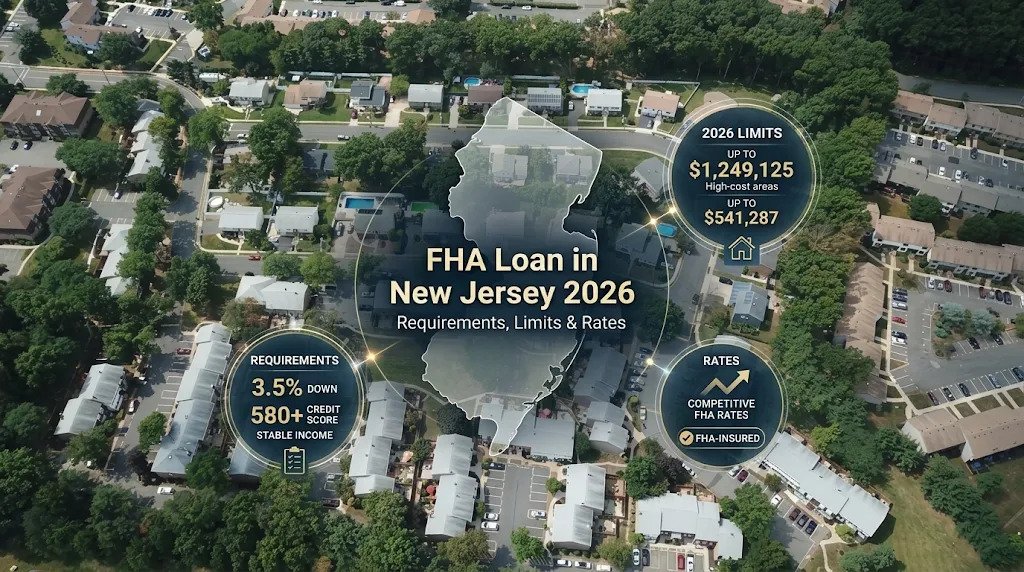

An FHA loan in New Jersey 2026 works the same way it works everywhere else in the country, because the FHA is a federal program and the rules do not change at the state line. What does change in New Jersey is the loan limit for your county, the price of the homes you are shopping for, and the property tax bill that lands in your monthly payment. Get those three things right and the rest of the process is straightforward.
Here is the short version. If your credit score is 580 or higher, you can buy with 3.5 percent down. If your score is between 500 and 579, you need 10 percent down. The 2026 FHA loan limit for a single family home in New Jersey runs from $541,287 in the lowest cost counties to $1,249,125 in the twelve high cost counties near New York City. You will also pay an upfront mortgage insurance premium of 1.75 percent of the loan amount, plus an annual premium of 0.55 percent for most borrowers, billed monthly. And because New Jersey has the highest property taxes in the country, your escrow payment deserves as much attention as your interest rate.
2026 FHA Loan Limits in New Jersey by County
The Department of Housing and Urban Development sets FHA loan limits every year. The 2026 limits come from HUD Mortgagee Letter 2025-23. The national floor for a one unit home is $541,287 and the national ceiling is $1,249,125. Your county decides which number applies to you, not your income and not your lender.
New Jersey has the widest spread of any state in the country. Twelve of its twenty one counties sit at the national ceiling, and only three sit at the floor. Crossing a county line can move your limit by more than $700,000 on the same house, so check your county before you start shopping.
| 2026 one unit limit | Counties |
|---|---|
| $1,249,125 | Bergen, Essex, Hudson, Hunterdon, Middlesex, Monmouth, Morris, Ocean, Passaic, Somerset, Sussex, Union |
| $730,250 | Atlantic, Cape May |
| $630,200 | Burlington, Camden, Gloucester, Salem |
| $541,287 | Cumberland, Mercer, Warren |
The same four tiers apply to two, three and four unit homes, which matter if you plan to buy a duplex or a small multifamily property and live in one unit while renting the others.
| County tier (one unit) | Two units | Three units | Four units |
|---|---|---|---|
| $1,249,125 | $1,599,375 | $1,933,200 | $2,402,625 |
| $730,250 | $934,850 | $1,130,000 | $1,404,350 |
| $630,200 | $806,750 | $975,200 | $1,211,950 |
| $541,287 | $693,050 | $837,700 | $1,041,125 |
One detail is worth knowing. In the twelve ceiling counties, the FHA limit of $1,249,125 is actually higher than the 2026 conforming loan limit of $1,209,750. In most of the country the FHA limit sits below the conventional limit, but in northern and central New Jersey FHA lets you borrow more than a standard conventional loan does. In the three floor counties the picture flips. There the FHA limit of $541,287 is far below the conforming baseline of $832,750, so a buyer in Trenton or Vineland who needs more than $541,287 in financing has to look at conventional options even with a small down payment.
FHA Loan Requirements in New Jersey
Because FHA rules are federal, the requirements in New Jersey match the national program exactly. HUD Handbook 4000.1 is the rulebook every FHA approved lender follows, in Newark the same as in Nevada. Here are the numbers that decide whether you qualify.
Credit score. You need a FICO score of 580 or higher to qualify with the minimum 3.5 percent down payment. With a score between 500 and 579, you can still get an FHA loan, but the down payment jumps to 10 percent. Below 500, FHA financing is not available. Lenders can add their own overlays on top of these minimums, so a lender that wants 620 for its own book is allowed to ask for it. If one lender turns you down, another may approve the same file, so it is worth getting a second opinion before giving up.
Down payment. The minimum is 3.5 percent of the purchase price with a 580 score. On a $400,000 home that is $14,000, and on a $600,000 home in Bergen County it is $21,000. Gift funds from a family member are allowed for the full down payment, and the New Jersey Housing and Mortgage Finance Agency offers down payment assistance that can cover part of it, which we cover below. What is not allowed is borrowing your down payment from a personal loan, because that debt counts against you in underwriting.

Debt to income ratio. The standard back end debt to income ceiling is 43 percent, meaning your total monthly debts including the new mortgage payment should stay under 43 percent of your gross monthly income. With compensating factors, such as strong cash reserves or a long stable job history, automated underwriting can approve ratios up to about 57 percent.
Income, employment and property. You need a steady two year employment history, or a documented explanation for gaps, such as school or a career change. Self employed borrowers should expect to show two years of tax returns. There is no maximum income limit on an FHA loan, which surprises a lot of buyers. The home must be your primary residence, and you have to move in within 60 days of closing. The home must also pass an FHA appraisal and meet HUD minimum property standards, covering the roof, foundation, heating, water and electrical safety. In New Jersey, older homes in cities such as Newark, Paterson and Camden are common, so budget for the possibility that the appraiser asks for repairs before closing.
What an FHA Loan Costs Each Month in New Jersey
The interest rate is only part of the monthly payment, and New Jersey proves it. Take a $500,000 home in Middlesex County with 3.5 percent down. The down payment is $17,500 and the base loan is $482,500. The upfront mortgage insurance premium is 1.75 percent of the base loan, which is $8,443.75, and most buyers finance it into the loan, bringing the total loan to about $490,944. The annual mortgage insurance premium is 0.55 percent of the base loan for most borrowers, which works out to about $221 a month in the first year.
Then add New Jersey property tax. The state has the highest effective property tax rate in the nation, around 2.23 percent of home value. On a $500,000 home that is roughly $11,150 a year, or about $929 a month in escrow. Homeowners insurance in New Jersey runs roughly $150 to $250 a month for a typical single family home, depending on the town, the age of the roof and flood zone status. Put it together at a rate near 7.9 percent and the total monthly payment lands around $4,700 to $4,900, of which the tax and insurance escrow is more than $1,100.
That tax number is the reason so many New Jersey buyers get surprised at the closing table. They shop the rate and forget the escrow. Before you make an offer, ask your loan officer for the exact monthly tax figure for that specific town, because the rate varies a lot between towns.
FHA Loan Rates in New Jersey Right Now
FHA rates are set by lenders, not by the FHA, and they move every day with the bond market. As of November 19, 2026, the average 30 year fixed FHA mortgage was about 7.91 percent APR, according to Money’s rate data, while the average conventional 30 year fixed was about 7.18 percent APR. FHA rates usually sit above conventional rates on paper, but the comparison is misleading, because FHA borrowers with lower credit scores often get a better rate through FHA than they would through conventional pricing, where the score drives the rate up sharply.
Your rate in New Jersey depends on your credit score, your down payment, the loan term and the lender you choose. A 30 year fixed is the most common choice. Three practical moves lower your rate. First, raise your credit score before you apply, even by 20 or 40 points, because FHA pricing improves in score bands. Second, compare at least three lenders on the same day, because quotes go stale within hours and lenders price the same borrower differently. Third, ask about a rate lock once you have a signed contract, and confirm how long the lock lasts and what it costs to extend it if closing slips.
Down Payment Assistance in New Jersey: NJHMFA
The New Jersey Housing and Mortgage Finance Agency, NJHMFA, is the state agency that helps first time buyers with down payment and closing cost assistance, and it pairs with FHA loans. Its programs offer between $10,000 and $22,000 in down payment assistance, typically structured as a five year forgivable loan, which means the assistance is forgiven a little at a time and disappears entirely if you stay in the home for five years.
To use NJHMFA help you generally need to be a first time buyer, meet income limits that vary by county and household size, complete a homebuyer education course, and buy a home under the program purchase price limits. The agency also runs a first generation homebuyer program with larger assistance for buyers whose parents never owned a home. Because program terms change, confirm the current amounts and income limits with NJHMFA or your lender before you count on them. There is also no mortgage recording tax on the loan itself in New Jersey, which saves buyers a fee that exists in some neighboring states.
How to Apply, and Mistakes to Avoid
Start with your credit. Pull your reports, fix errors, and pay down revolving balances if you can, because even a small score improvement can change your rate and your approval. Next, gather your documents: two years of tax returns, recent pay stubs, two months of bank statements, and a photo ID. Then get preapproved, not just prequalified, because a preapproval means the lender has reviewed your documents and run your file through automated underwriting, and New Jersey sellers take preapproved offers far more seriously. While you shop, keep your finances frozen. Do not open new credit cards, do not buy a car, and do not move large sums between accounts without a paper trail. Once your offer is accepted, the lender orders the FHA appraisal. If the appraiser flags repairs, negotiate who pays for them before the closing date approaches. The whole process typically takes 30 to 45 days in New Jersey.
Four mistakes catch New Jersey buyers most often. The first is shopping for a home above the county limit and discovering it only after the offer is accepted, so check the limit before you tour homes. The second is underestimating the monthly payment because the tax escrow was never calculated for that town. The third is assuming mortgage insurance drops off automatically, as it does on a conventional loan. On an FHA loan with less than 10 percent down, the annual premium lasts for the life of the loan, and the only way out is refinancing into a conventional loan once you have 20 percent equity. The fourth is skipping the NJHMFA assistance because it sounds complicated. The paperwork is real, but $10,000 to $22,000 of forgivable help is worth a few extra forms. One more mistake is specific to New Jersey: ignoring flood zones. Parts of the Jersey Shore, the Meadowlands and river towns sit in flood zones, and flood insurance can add hundreds of dollars a month, so check the flood map for any home near water before you make an offer.
Is an FHA Loan the Right Choice in New Jersey?
An FHA loan is the right choice for many New Jersey buyers, especially first time buyers with a credit score in the 580 to 680 range, buyers with a small down payment, and buyers whose debt to income ratio is too high for conventional approval. The low down payment and forgiving credit rules open doors that conventional loans keep shut, and in the twelve ceiling counties the FHA limit is generous enough to cover most homes.
It is a weaker choice if you have a score above 700, a 20 percent down payment, and low debt, because then a conventional loan usually wins on total cost, mainly because it has no lifetime mortgage insurance. It is also the wrong tool if the home you want costs more than your county limit, in which case you need conventional or jumbo
financing. The honest way to decide is to ask a lender to price both options side by side on the same home, with the same down payment, and compare the total monthly payment and the total cost over five years.
Frequently Asked Questions
What is the 2026 FHA loan limit in New Jersey?
It depends on the county. Twelve counties, including Bergen, Essex, Hudson, Middlesex, Monmouth and Morris, are at the national ceiling of $1,249,125 for a one unit home. Atlantic and Cape May are at $730,250. Burlington, Camden, Gloucester and Salem are at $630,200. Cumberland, Mercer and Warren are at the national floor of $541,287.
What credit score do I need for an FHA loan in New Jersey?
You need a FICO score of 580 or higher for the minimum 3.5 percent down payment. With a score of 500 to 579 you can still qualify, but the down payment rises to 10 percent. Below 500, FHA financing is not available, and some lenders add their own higher minimums on top of the FHA floor.
How much is the down payment on an FHA loan in New Jersey?
The minimum is 3.5 percent of the purchase price with a 580 credit score. On a $400,000 home that is $14,000. On a $600,000 home it is $21,000. Gift funds from family are allowed, and NJHMFA down payment assistance of $10,000 to $22,000 can help cover it.
What are current FHA loan rates in New Jersey?
Rates change daily and are set by lenders. As of November 19, 2026, the average 30 year fixed FHA mortgage was about 7.91 percent APR nationally. Your rate depends on your credit score, down payment, loan term and lender, so compare at least three lenders on the same day.
Does New Jersey have down payment assistance for FHA buyers?
Yes. The New Jersey Housing and Mortgage Finance Agency offers $10,000 to $22,000 in down payment assistance, usually as a five year forgivable loan, for first time buyers who meet income and purchase price limits and complete a homebuyer education course.
Can I use an FHA loan to buy a condo in New Jersey?
Yes, if the condo project is on the FHA approved condo list or meets the single unit approval rules. Ask your lender to check the project approval before you make an offer, because an unapproved condo cannot be financed with an FHA loan.
Can I buy a multifamily home in New Jersey with an FHA loan?
Yes. You can buy a two to four unit property with an FHA loan if you live in one unit as your primary residence. The 2026 limits are higher for multifamily homes, up to $2,402,625 for a four unit property in the ceiling counties, and rental income from the other units can help you qualify.
How long does it take to close on an FHA loan in New Jersey?
Typically 30 to 45 days from a signed contract to closing. Appraisal repairs, flood insurance quotes and seller repair timelines are the most common causes of delay, so build extra time into your contract if the home is older or near water.
Do I have to pay mortgage insurance on an FHA loan in New Jersey?
Yes. Every FHA loan carries an upfront mortgage insurance premium of 1.75 percent of the loan amount, usually financed into the loan, plus an annual premium of 0.55 percent for most borrowers, billed monthly. With less than 10 percent down, the annual premium lasts for the life of the loan.
Are FHA loan requirements different in New Jersey than in other states?
No. Credit score, down payment, debt to income and property standards are federal rules from HUD Handbook 4000.1 and apply the same way everywhere. What differs in New Jersey is the county loan limit, the home prices, the property taxes and the state assistance programs.
Can I get an FHA loan in New Jersey with a 500 credit score?
Yes, if your score is between 500 and 579 you can qualify with a 10 percent down payment. Many lenders add their own overlays and want a higher score, so if one lender declines you, try another FHA approved lender before giving up.
Is an FHA loan better than a conventional loan in New Jersey?
It depends on your profile. FHA is usually better for buyers with lower credit scores, small down payments or higher debt ratios, and in the twelve ceiling counties the FHA limit is higher than the conforming limit. Conventional is usually cheaper for buyers with strong credit and 20 percent down, because it has no lifetime mortgage insurance.
#FHALoan #NewJersey #FHALoanLimits2026 #FirstTimeHomeBuyer #NJHMFA #MortgageTips