


Buying your first home is exciting, and a little overwhelming, with forms to gather, numbers to check, and deadlines to hit. That is exactly what this first-time home buyer FHA loan checklist is for. It walks you through the whole process in order, from checking your credit to holding the keys.
An FHA loan is a popular first mortgage because the down payment is low and the credit rules are flexible: with a score of 580 or higher, you can buy with just 3.5 percent down, and with 500 to 579 you can still qualify with 10 percent down. Work through this checklist one step at a time.
Check Your Credit First
Your credit score decides your down payment and your interest rate, so check it first. Get your reports free from the three major bureaus, and look at all three, since errors are common. If you find a mistake, such as an account that is not yours, dispute it right away. A correction can take 30 to 45 days, so start early.
If your score is below 580, work on raising it before you apply: pay every bill on time, pay down credit card balances, and do not open new accounts or close old ones. Even a small improvement matters: moving from 575 to 580 cuts your down payment from 10 percent to 3.5 percent, a difference of $19,500 on a $300,000 home.
Plan Your Down Payment and Savings
With an FHA loan, the minimum down payment is 3.5 percent of the purchase price if your credit score is 580 or higher. On a $300,000 home, that is $10,500. With a score between 500 and 579, the minimum rises to 10 percent, or $30,000 on the same home. But the down payment is not the only cash you need: budget for closing costs of 2 to 6 percent of the price, plus moving costs and a small cushion.
Gift funds can help: FHA rules allow a family member to gift you the down payment, with a letter stating the money does not need to be repaid. Down payment assistance programs can help too. Ask your lender or a local housing counselor what is available in your area.
Gather Your Documents
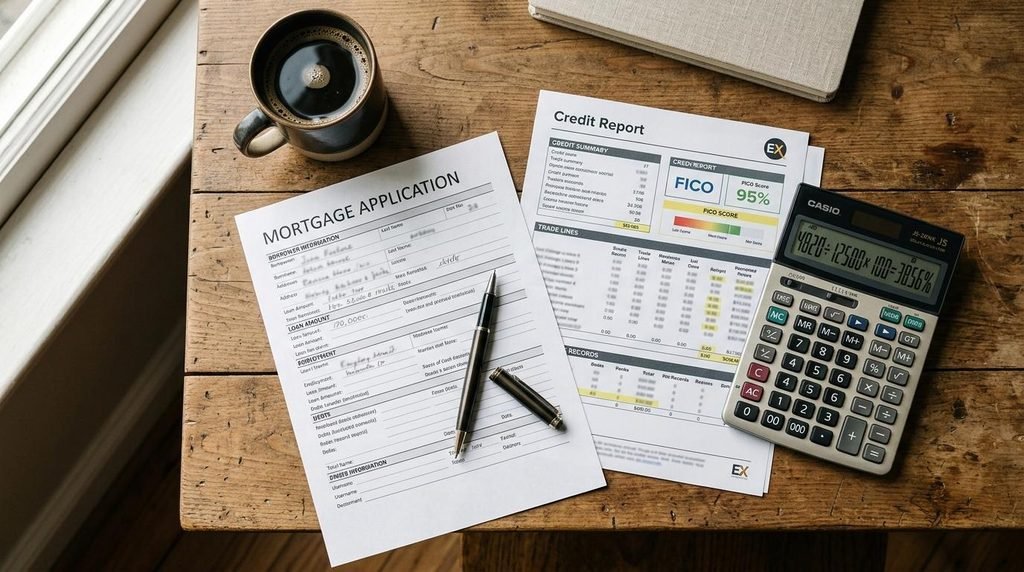
Lenders ask for a lot of paperwork, and having it ready speeds everything up. Pull these together before you apply: a photo ID, Social Security number, pay stubs from the last 30 days, W-2 forms for the last two years, and federal tax returns for the last two years. Add bank statements for the last two months, records of any other income, such as child support or a second job, and statements for debts such as car loans, student loans, and credit cards. Self-employed buyers will also need profit and loss statements and business tax returns.
Keep your finances steady while you gather all this. Lenders look at large deposits they cannot explain, so keep the paper trail if you move money or receive a gift. Do not open new credit accounts or make big purchases until after closing, since new debt can change your approval.
Get Pre-Approved Before You Shop
Pre-approval is not the same as pre-qualification, which is a rough estimate based on what you tell a lender. Pre-approval means the lender has checked your credit, verified your income, and told you in writing how much you can borrow. Sellers take it seriously, and in a competitive market it can be the difference between getting the home and losing it.
Apply with two or three lenders and compare their Loan Estimates: the interest rate, the monthly payment, and the closing costs. Rate shopping within a short window, usually 14 to 45 days, is generally counted as a single credit inquiry. A pre-approval is usually good for 60 to 90 days, so time it for when you are ready to start looking.
Find the Right Home and Make an Offer
With a pre-approval in hand, start your search with a clear budget. It tells you the maximum you can borrow, but that is not the same as what you can comfortably pay each month. Add up the full monthly cost: principal and interest, property taxes, homeowners insurance, mortgage insurance, and any HOA fees. Keep your total housing payment at or below 30 percent of your gross monthly income.
When you find a home you like, your agent will help you make an offer. FHA buyers can ask the seller to contribute toward closing costs, up to 6 percent of the price. Include an FHA appraisal contingency, so you are protected if the appraisal comes in below the agreed price.
The FHA Appraisal and Inspection
Once your offer is accepted, two checks happen. The FHA appraisal, ordered by your lender, sets the home’s value and confirms it meets FHA minimum property standards. The appraiser looks at the structure, roof, heating and plumbing, and safety issues such as peeling paint or broken windows. If repairs are needed, they must usually be fixed before closing.
The home inspection is separate, and it is for you, not the lender. A licensed inspector examines the home in detail, including problems the appraisal may not catch. It usually costs $300 to $500 and is money well spent. If it turns up a major issue, such as a failing roof, you can ask the seller to fix it, lower the price, or walk away.
Know the 2026 FHA Loan Limits
FHA loan limits cap how much you can borrow, and they change every year. HUD sets them by county, based on local home prices. For 2026, a one-unit home runs from a floor of $541,287 in most counties to a ceiling of $1,249,125 in the most expensive markets. Check your county on the HUD website before you shop, since the limit decides the maximum price you can finance.
| Property type | Low-cost areas (floor) | High-cost areas (ceiling) |
|---|---|---|
| 1 unit | $541,287 | $1,249,125 |
| 2 units | $693,050 | $1,599,375 |
| 3 units | $837,700 | $1,933,200 |
| 4 units | $1,041,125 | $2,402,625 |
These limits apply to FHA case numbers assigned on or after January 1, 2026. If the home you want costs more than your county limit, you will need a larger down payment or a different loan type.
Understand Mortgage Insurance
Every FHA loan comes with mortgage insurance premium, or MIP, in two parts. The upfront premium is 1.75 percent of the loan amount, and most borrowers finance it into the loan. The annual premium is currently 0.55 percent of the loan balance for most 30 year loans, paid monthly. On a $300,000 loan, that is about $137 a month.
For most borrowers who put less than 10 percent down after June 2013, MIP lasts for the life of the loan and does not cancel at 20 percent equity. The usual way out is to refinance into a conventional loan later, once you have enough equity and a strong credit score. FHA.com explains the current MIP rules in plain language.
Closing Day and Moving In

About three business days before closing, your lender sends the closing disclosure, listing your final loan terms, monthly payment, and the exact cash you need to bring. Read it line by line and compare it with your Loan Estimate. If any fee jumped sharply, ask why before you sign. The Consumer Financial Protection Bureau has a guide to reading it that is worth a look first.
On closing day, bring a photo ID and a cashier’s check or wire transfer for the amount due. You will sign the mortgage note, the deed, and a stack of disclosures. Take your time and ask about anything you do not understand. Once everything is signed and recorded, you get the keys.
Mistakes to Avoid on Your First-Time Home Buyer FHA Loan Checklist
The most common mistake is shopping for homes before getting pre-approved, which risks losing a home you love to a buyer who is ready. The second is draining your savings on the down payment and leaving nothing for closing costs, moving, and emergencies. The third is skipping the home inspection to save a few hundred dollars, which can cost thousands later. The fourth is opening new credit or making big purchases during the process. And the fifth is focusing only on the interest rate while ignoring the total monthly payment, including taxes, insurance, and MIP.
The Bottom Line
Buying your first home with an FHA loan is very doable when you take it step by step: check your credit, save for the down payment and closing costs, gather your documents, get pre-approved, find a home within your county limit, and read every document before you sign. Ask your lender or a housing counselor whenever a step is unclear.
Frequently Asked Questions
#FirstTimeHomeBuyerFHALoanChecklist #FHALoanChecklist2026 #FirstTimeHomeBuyer #FHALoan #FHARequirements #BuyYourFirstHome






