


Buying a home with an FHA loan can involve more than just saving for a down payment. Buyers also need to prepare for lender fees, title expenses, prepaid property taxes, homeowners insurance, and other closing costs. Understanding the FHA Seller Concessions 6% Limit and Closing Cost Rules can help buyers negotiate financial assistance before signing a purchase agreement.
FHA financing allows sellers and certain other interested parties to contribute toward eligible buyer expenses. This assistance can reduce the amount of money a buyer needs to bring to closing, making homeownership more manageable.
The FHA seller concession limit is generally 6% of the home’s sales price. However, this does not mean buyers automatically receive 6% in cash. The contribution must follow FHA guidelines and cover eligible expenses. It cannot replace the borrower’s required minimum down payment.
This guide explains how the 6% limit works in 2026, which expenses sellers can pay, what happens when contributions exceed the limit, and how buyers can negotiate credits effectively.
What Are FHA Seller Concessions?
FHA seller concessions are financial contributions that a home seller agrees to make toward certain expenses normally paid by the buyer during a real estate transaction.
HUD refers to these contributions as Interested Party Contributions (IPCs). They may come from sellers, builders, developers, real estate agents, or other parties with a financial interest in the transaction.
For example, imagine purchasing a house for $300,000. Your seller agrees to contribute $8,000 toward eligible closing costs.
Instead of paying the entire $8,000 yourself, the seller’s contribution reduces your eligible expenses at closing.
Seller concessions are particularly helpful for:
- First-time homebuyers with limited savings.
- Buyers who can afford their down payment but need help with closing expenses.
- Families trying to preserve emergency savings.
- Buyers negotiating with sellers in a slower housing market.
However, these contributions must be properly documented and approved by the mortgage lender.
FHA Seller Concessions 6% Limit: How Does It Work in 2026?
The FHA seller concession limit is generally 6% of the property’s sales price, not 6% of the mortgage amount.
This distinction matters because the sales price and final mortgage amount are not necessarily the same.
For example, if a property sells for $300,000, the maximum percentage-based contribution is:
\[ \$300,000 \times 0.06 = \$18,000 \]
The seller may contribute up to $18,000 toward eligible expenses, subject to FHA requirements.
FHA Seller Concession Limit Examples
Here is how the 6% calculation works at different purchase prices:
| Home Sales Price | Maximum 6% Contribution |
|---|---|
| $200,000 | $12,000 |
| $250,000 | $15,000 |
| $300,000 | $18,000 |
| $350,000 | $21,000 |
| $400,000 | $24,000 |
| $450,000 | $27,000 |
| $500,000 | $30,000 |
These figures represent percentage-based maximums, not guaranteed credits.
For instance, if your eligible closing costs total $11,000 on a $300,000 property, you cannot automatically receive the remaining $7,000 as cash.
Your lender must verify that every contribution is permitted under FHA guidelines.
Important: HUD’s FHA Single Family Housing Policy Handbook 4000.1 is the primary policy reference for lenders. Its current published version was updated August 12, 2026. Check the applicable handbook provisions with your lender before finalizing a transaction.

Is the 6% Limit Based on Sales Price or Appraised Value?
The general FHA interested party contribution limit is calculated using the sales price.
Consider this example:
- Agreed purchase price: $300,000
- Appraised property value: $285,000
- Maximum 6% contribution based on sales price: $18,000
A lower appraisal does not automatically change the contribution calculation to 6% of $285,000.
However, the appraisal can affect your mortgage financing. If the home appraises below the agreed purchase price, you may need to renegotiate or bring additional funds to cover the difference.
What Closing Costs Can FHA Seller Concessions Cover?
One of the biggest advantages of FHA seller concessions is that they can cover several expenses associated with obtaining a mortgage.
Under applicable FHA rules, interested party contributions can generally cover eligible origination charges, closing costs, prepaid expenses, and discount points.
Here are some common examples.
1. Mortgage Origination and Lender Fees
Sellers may contribute toward eligible charges associated with processing and approving the mortgage.
These can include:
- Loan origination fees.
- Underwriting charges.
- Processing fees.
- Other eligible lender-related expenses.
The lender must determine whether individual charges qualify.
2. Title and Settlement Expenses
Property transactions involve several services to transfer ownership legally.
Eligible expenses may include:
- Title search charges.
- Settlement fees.
- Title-related services.
- Attorney fees where applicable.
- Other eligible closing services.
3. Prepaid Property Taxes and Insurance
Buyers may need to pay certain expenses before their mortgage payments begin.
Seller contributions can generally cover eligible prepaid expenses, such as:
- Homeowners insurance premiums.
- Property tax payments.
- Initial escrow deposits where permitted.
- Other eligible prepaid items.
These costs can add up, especially when property taxes and insurance premiums are substantial.
4. Mortgage Discount Points and Rate Buydowns
Buyers can also negotiate seller contributions toward eligible mortgage discount points.
Discount points are upfront charges paid to reduce the mortgage interest rate.
For example, a seller might agree to contribute $3,000 toward discount points to help a buyer secure a lower interest rate.
Permanent and temporary rate buydowns may also qualify, subject to lender and FHA requirements.
5. Upfront FHA Mortgage Insurance Premium
FHA loans generally include an upfront mortgage insurance premium (UFMIP).
Eligible seller contributions may be applied toward this expense under FHA guidelines.
The upfront premium is separate from the buyer’s required minimum investment.
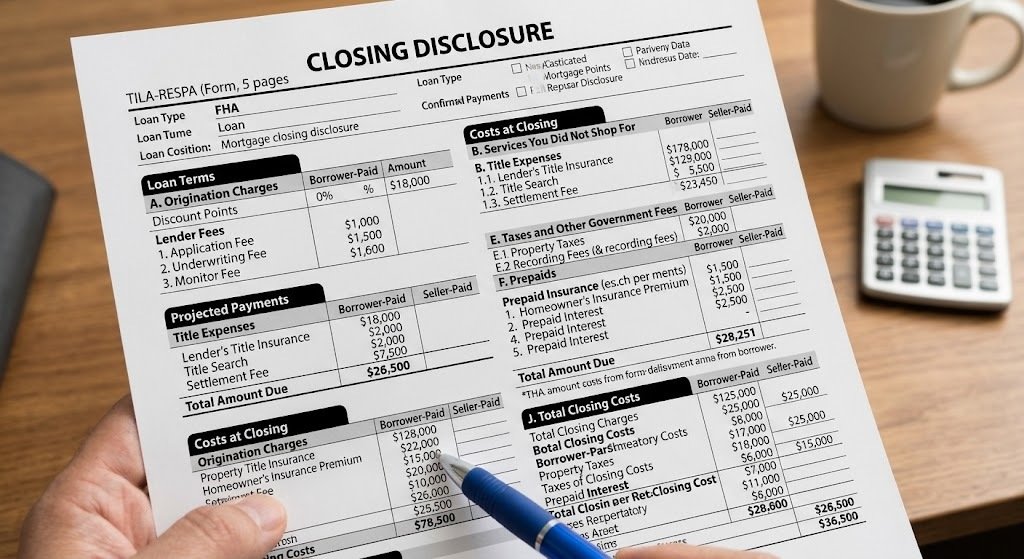
What Expenses Cannot Be Paid Through FHA Seller Concessions?
Although the 6% limit provides meaningful assistance, not every expense qualifies.
Understanding the restrictions can prevent problems during underwriting.
| Expense | FHA Seller Concession Treatment |
|---|---|
| Required FHA down payment | Not allowed |
| Credit card debt repayment | Not generally an eligible closing-cost use |
| Personal loans | Not generally eligible |
| Future mortgage payments | Not allowed as unrestricted cash |
| Unused seller credit | Cannot be paid to the buyer as unrestricted cash |
| Eligible lender fees | Generally allowed |
| Eligible prepaid taxes and insurance | Generally allowed |
| Eligible discount points | Generally allowed |
Can FHA Seller Concessions Pay the Down Payment?
No. Seller concessions cannot replace the borrower’s required FHA minimum investment.
For a borrower eligible for the standard 3.5% minimum down payment, a $300,000 purchase would require:
\[ \$300,000 \times 0.035 = \$10,500 \]
The buyer must meet the minimum investment requirement using an acceptable source of funds.
Depending on eligibility and documentation, acceptable sources can include personal savings, qualifying gift funds, and approved down payment assistance.
This is an important distinction: seller credits can reduce eligible closing expenses, but they do not automatically eliminate the buyer’s down payment responsibility.
The FHA rules also distinguish between seller contributions and properly documented assistance from eligible sources.
What Happens If Seller Concessions Exceed the 6% FHA Limit?
If seller contributions exceed the permitted amount, the excess may be treated as an inducement to purchase under FHA rules.
An inducement to purchase is a financial benefit provided by an interested party that is not permitted as an ordinary contribution toward eligible buyer costs.
This can affect the property’s value used to calculate the maximum FHA mortgage.
Example of Seller Contributions Above the Limit
Suppose a buyer purchases a home for $300,000.
| Item | Amount |
|---|---|
| Purchase price | $300,000 |
| FHA 6% limit | $18,000 |
| Seller’s proposed contribution | $20,000 |
| Amount above the limit | $2,000 |
The additional $2,000 cannot simply be handed to the buyer or added to the down payment.
The lender must review the transaction and determine how the excess affects FHA calculations. The parties may need to restructure the agreement.
Another important issue is that contributions exceeding actual eligible expenses cannot automatically be converted into cash.
For this reason, buyers should request a realistic seller credit based on their estimated closing costs rather than negotiating an arbitrary maximum.
How Can Buyers Negotiate FHA Seller Concessions?
Negotiating seller concessions requires understanding both the property’s price and the buyer’s estimated expenses.
A well-structured offer can help reduce upfront costs without creating unnecessary underwriting problems.
Step 1: Calculate Your Estimated Closing Costs
Before making an offer, request a Loan Estimate from your mortgage lender.
Review expenses such as:
- Lender origination charges.
- Appraisal and eligible third-party fees.
- Title and settlement costs.
- Prepaid homeowners insurance.
- Property taxes and escrow deposits.
- Discount points.
This gives you a realistic idea of how much seller assistance you may need.
Step 2: Include the Seller Credit in Your Purchase Agreement
The negotiated contribution should be clearly documented in the purchase agreement or another appropriate legally binding document.
For example:
The seller agrees to contribute up to $10,000 toward the buyer’s eligible closing costs and prepaid expenses, subject to FHA guidelines and lender approval.
The exact wording should be reviewed by your real estate agent and lender.
Step 3: Confirm the Credit With Your Mortgage Lender
Do not assume every expense will qualify.
Ask your lender to review the proposed credit and explain how it will appear on the final Closing Disclosure.
This is especially important when the seller is paying discount points or funding a temporary interest rate buydown.
Step 4: Compare a Seller Credit With a Price Reduction
Sometimes a lower purchase price is more beneficial than a seller concession.
Consider the following hypothetical situation:
A buyer has two options for a $300,000 property:
| Option | Purchase Price | Seller Credit |
|---|---|---|
| Option A | $300,000 | $8,000 |
| Option B | $292,000 | $0 |
Option A may reduce immediate cash-to-close requirements, while Option B may reduce the amount financed and potentially lower monthly payments.
The better choice depends on the buyer’s cash reserves, interest rate, appraisal, loan structure, and actual eligible expenses.
A useful approach is to ask the lender to calculate both options side by side before submitting an offer.

FHA Seller Concessions vs. Conventional and VA Loans
Seller contribution rules vary between mortgage programs. Buyers should understand these differences before choosing financing.
| Loan Type | General Contribution Limit |
|---|---|
| FHA | 6% of sales price |
| Conventional | Generally 3%, 6%, or 9%, depending on LTV and occupancy |
| VA | 4% limit on expenses classified as VA seller concessions |
| USDA | Generally 6% of sales price |
FHA loans: Interested party contributions are generally limited to 6% of the sales price for eligible expenses.
Conventional loans: Contribution limits depend on the loan-to-value ratio and whether the property is a primary residence, second home, or investment property.
VA loans: The 4% rule applies to specific expenses classified as seller concessions. It is not a blanket limit on all ordinary seller-paid closing costs.
USDA loans: Eligible interested party contributions can generally reach 6% of the sales price.
These programs use different definitions and restrictions, so their percentages should not be compared without considering which expenses are included.
For additional information, review the official program guidelines:
- FHA Single Family Housing Policy Handbook – HUD
- FHA Seller and Interested Party Contributions – HUD
- VA Home Loan Program – Department of Veterans Affairs
Common Mistakes Buyers Should Avoid
Even when buyers understand the FHA 6% limit, certain mistakes can create confusion during closing.
Here are some important issues to avoid:
- Confusing the sales price with the loan amount: The general 6% contribution calculation uses the sales price.
- Expecting unused credits as cash: Unused seller concessions cannot simply be refunded to the buyer.
- Using seller credits for the down payment: FHA requires the borrower to meet the minimum investment separately.
- Ignoring discount points: Seller-funded rate buydowns and discount points generally count toward the contribution limit.
- Not documenting the agreement: Seller credits should be properly disclosed and approved.
- Ignoring appraisal differences: A low appraisal can affect financing even when the seller credit is within the 6% limit.
A buyer who reviews these details before signing a contract can avoid many last-minute closing problems.
Conclusion: Understand the FHA 6% Seller Concession Rule Before Closing
The FHA Seller Concessions 6% Limit and Closing Cost Rules provide an opportunity for homebuyers to reduce eligible upfront expenses when purchasing a property.
In general, sellers and other qualifying interested parties can contribute up to 6% of the home’s sales price toward permitted borrower expenses. However, the contribution cannot replace the required FHA down payment or become unrestricted cash for the buyer.
Before negotiating, calculate your expected closing costs, discuss eligible expenses with your lender, and ensure that all seller contributions are properly documented.
Planning to purchase a home with an FHA loan? Speak with an FHA-approved mortgage lender to review your estimated closing costs and determine how seller concessions could fit into your purchase agreement.
FAQ Section
What Is the FHA Seller Concession Limit in 2026?
The FHA seller concession limit is generally 6% of the property’s sales price. Sellers can contribute toward eligible closing costs, prepaid expenses, and other permitted mortgage-related charges.
Can FHA Sellers Pay 100% of Closing Costs?
Yes, a seller may cover all eligible buyer closing costs if the contributions meet FHA requirements and remain within the applicable limits.
Can FHA Seller Concessions Be Used for a Down Payment?
No. Seller concessions cannot satisfy the borrower’s required FHA minimum investment. Buyers must use another acceptable source for their down payment.
What Happens When Seller Concessions Exceed 6%?
Contributions above the permitted limit may be treated as an inducement to purchase. This can affect the property’s adjusted value and maximum mortgage calculation.
Are FHA Seller Concessions Calculated on the Loan Amount?
No. The general 6% FHA contribution limit is calculated using the property’s sales price, not the mortgage amount.
Can FHA Seller Concessions Pay Mortgage Discount Points?
Yes. Eligible permanent and temporary interest rate buydowns and discount points may be covered, subject to FHA contribution limits and lender approval.