


Mortgage rates move every day, sometimes by the hour. Between signing a purchase contract and closing, a rate can climb enough to add hundreds of dollars a year to your payment. A rate lock stops that drift. When you lock an FHA loan rate with your lender, the rate is held for a set number of days, no matter what the market does in between. This guide explains what a lock is, when to lock, how it works, what it costs, and what to do if closing runs late.
What Locking an FHA Loan Rate Means
A rate lock is a written agreement between you and your lender. The lender promises to hold a specific interest rate, and usually a specific set of discount points and fees, for a defined period, regardless of what happens to market rates in the meantime. The Consumer Financial Protection Bureau puts it simply. If your rate is locked, your rate will not change between the offer and closing, as long as you close within the specified time frame and there are no changes to your application.
A lock is not a quote. A quote is what the rate is today; a lock guarantees the rate will still be there at closing. It also is not a loan approval.
When to Lock Your FHA Rate
The simple rule is to lock an FHA loan rate when you have a property under contract and a reasonable estimate of when you will close. Most buyers lock within a day or two of signing the purchase contract, when the closing date is set and the lender has enough information to price the loan.
Waiting to lock is called floating. It makes sense only if you have a real reason to expect rates to fall soon and you can afford the risk if they rise instead. For most FHA buyers, the safer choice is to lock once the rate on offer fits the monthly payment you budgeted for. FHA loans often take 30 to 45 days to close, sometimes 45 to 60 days. If rates rose by half a point tomorrow and you could no longer afford the payment, lock now.
How to Lock an FHA Loan Rate, Step by Step

Step 1: Get preapproved and find a home. A lock comes after preapproval, once your offer is accepted.
Step 2: Submit your full loan application. You will receive a Loan Estimate within three business days of applying. Check the top of page 1. It tells you whether your rate is locked and for how long. Do not assume it is locked until you see it in writing.
Step 3: Compare the options to lock an FHA loan rate. Ask your lender for pricing on a 30 day, a 45 day, and a 60 day lock.
Step 4: Choose your lock period. Pick the period that covers your closing date with a cushion of about a week. If your contract says 35 days to close, a 45 day lock is usually the right call.
Step 5: Confirm the lock in writing. Get a written lock confirmation listing the rate, points, lock period, expiration date, and what happens if the lock expires.
Step 6: Keep your application frozen. After you lock, do not open new credit, take on new debt, or change jobs without telling your lender first. Changes such as a different loan type, a credit score change, or income the lender cannot document can still move a locked rate.
Step 7: Track the lock to closing. Ask your lender for weekly updates on where the file stands against the expiration date.
Choosing Your Lock Period: 30, 45 or 60 Days
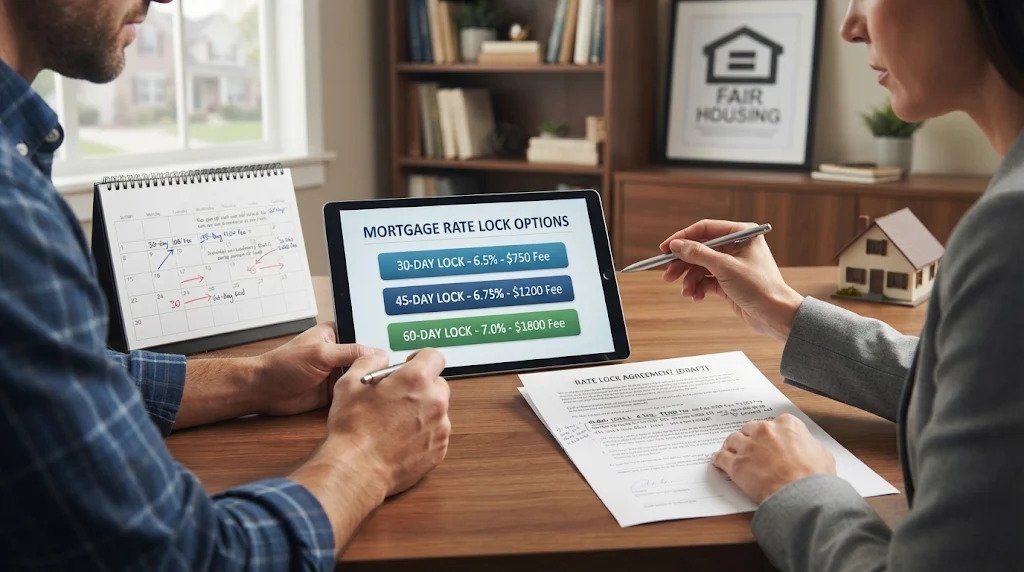
Lock periods come in standard lengths, most commonly 30, 45, and 60 days, with some lenders offering 75 or 90 day locks. The longer the lock, the more it costs the lender to hedge the rate, and that cost is passed to you as a slightly higher rate or a point based fee.
| Lock period | Typical use | Cost impact |
|---|---|---|
| 30 days | Standard purchase, on-time close | Lowest, often no fee at this rate |
| 45 days | Slightly complex files, builder delays | Small rate bump or about 0.25 points |
| 60 days | Slow underwriting, long escrow | About 0.25 to 0.50 points or a rate bump |
| 90 days | New construction, long timelines | Highest cost, ask for exact pricing |
A 30 day lock is the cheapest option, but FHA closings often run past 30 days, so use it only if you have high confidence in your closing timeline. A 45 day lock is the most common choice for a typical FHA purchase: enough buffer for inspection, appraisal, and underwriting while keeping the cost reasonable.
What a Rate Lock Costs
A standard 30 or 45 day lock often costs nothing upfront. The lender builds the cost of hedging into the rate itself, so you may not see a separate fee at all. A 60 day lock typically costs about 0.25 to 0.50 points, or the same amount as a small increase in the rate. Ask before you lock: is there a lock fee, is it refundable, and what does an extension cost? To see how the rate you lock affects your real monthly cost, run the numbers with our FHA loan down payment calculator.
What a Rate Lock Does Not Protect You From
A lock protects you from market moves, not from changes in your own file. The CFPB is clear on this point. Your locked rate can still change if there are changes to your application. Common triggers include switching the loan type or the down payment amount, an appraisal that comes in higher or lower than expected, a change in your credit score from a new loan or a missed payment, and income your lender cannot document, such as overtime or bonuses. A lock also does not freeze your whole payment: property taxes and homeowners insurance are recalculated every year.
The Float-Down Option: Can You Still Catch a Lower Rate?
A float-down rider lets you take a lower rate if market rates fall after you lock. The typical terms are consistent across the industry. You can use it once during the lock period. Rates must drop by at least 0.25 percent from your locked rate, and some lenders require a drop of 0.50 percent. It costs about 0.125 to 0.50 percent of the loan amount, paid upfront or rolled into the rate.
For example, if you lock at 7.00 percent and rates fall to 6.50 percent, a float-down could move you to a lower rate. Without the rider, you would stay at 7.00 percent. Float-downs are worth considering when you are locking 45 or more days before closing and rates are at a recent high. Ask your lender whether they offer float-downs and what the trigger is.
What Happens If Your Lock Expires
Lock expiration is one of the most expensive surprises in home buying. If your loan does not close before the lock expires, you have two options, and neither is free. The first is a lock extension. The lender extends the lock for a set number of days, typically 7 to 15 days at a time, for a fee of about 0.125 to 0.375 percent of the loan amount per extension. On a $300,000 loan, that is roughly $375 to $1,125 per extension. If the delay is the lender’s fault, some lenders will absorb the cost, so ask before you need it.
The second is to re-lock at current market rates. If rates have fallen, this can be the better option. If rates have risen, most lenders apply a worse of rule: they use the higher of your original locked rate or the current market rate. Most lock expirations are caused by borrower delays, so respond to every document request the same day you receive it.
Mistakes to Avoid and Questions to Ask Before You Lock
The first mistake is locking too short. A 30 day lock on a file that needs 45 days is the most common error, and it costs more in extension fees than a 45 day lock would have cost upfront. The second is assuming the rate is locked when it is not. A Loan Estimate with a rate on it is not proof of a lock, so check the top of page 1 and get a separate written lock confirmation.
The third is changing your finances after locking: a new car loan, a new credit card, or a large cash deposit can move a locked rate or delay the file past expiration. The fourth is comparing locks on rate alone. Compare the full Loan Estimate, not just the headline rate.
Ask these before you say yes. What lock periods do you offer, what does each cost, is there a refundable lock fee, what exactly is locked, when does it expire, what does an extension cost, and do you offer a float-down? For context on how the rate you lock fits into the whole cost of the loan, read our guide on how much down payment you need for an FHA loan on a $300,000 home.
How do I lock an FHA loan rate?
Tell your lender you want to lock after your offer is accepted and your application is submitted. Choose a lock period, usually 30, 45 or 60 days, and get a written lock confirmation. That is how you lock an FHA loan rate.
When is the best time to lock an FHA loan rate?
Usually within a day or two of signing the purchase contract, once you know the closing date. Lock when the rate fits the monthly payment you budgeted for. That is the best time to lock an FHA loan rate.
How long does an FHA rate lock last?
Most locks run 30, 45 or 60 days, and some lenders offer 75 or 90 day locks. That is how long you can lock an FHA loan rate for.
Does it cost money to lock a mortgage rate?
A standard 30 or 45 day lock often costs nothing upfront. Longer locks typically cost about 0.25 to 0.50 points, or the same amount as a small increase in the rate.
What is a float-down option?
A float-down lets you take a lower rate once during the lock period if market rates fall by a set amount, usually at least 0.25 percent. It typically costs 0.125 to 0.50 percent of the loan amount.
What happens if my rate lock expires before closing?
You can extend the lock for a fee, usually about 0.125 to 0.375 percent of the loan amount per 7 to 15 day extension, or re-lock at current market rates.
Can my locked rate still change?
Yes, if your application changes, for example a different loan type, a new appraisal value, a credit score change, or income the lender cannot document.
Does locking a rate commit me to that lender?
No. A rate lock commits the lender, not you. You can walk away before signing the closing documents, although fees already paid may not be refunded.
How do I know if my rate is locked?
Check the top of page 1 of your Loan Estimate, which states whether the rate is locked and for how long. Ask your lender for a separate written lock confirmation as well.
Should I lock for 30 or 45 days on an FHA loan?
A 45 day lock is usually the safer choice for an FHA purchase, because FHA closings often run 30 to 45 days and sometimes longer. That is why many buyers lock an FHA loan rate for 45 days.
Can I lock a rate before I find a house?
Some lenders offer lock and shop programs that lock a rate for 60 to 90 days before you have a property under contract. These usually carry a rate premium of about 0.25 to 0.50 percent.
Does an FHA rate lock cover discount points too?
Usually yes. A lock normally covers the interest rate plus the discount points and lender credits priced with it. Confirm this in your written lock confirmation before you lock an FHA loan rate.
#FHALoanRates #MortgageRateLock #FHAloan #HomeBuying #MortgageRates #FirstTimeHomeBuyer





